Full powerpoint here
Excerpts:


Farrar, W. V. “Andrew Ure, F.R.S., and the Philosophy of Manufactures.” Notes and Records of the Royal Society of London 27.2 (1973): 299-324.
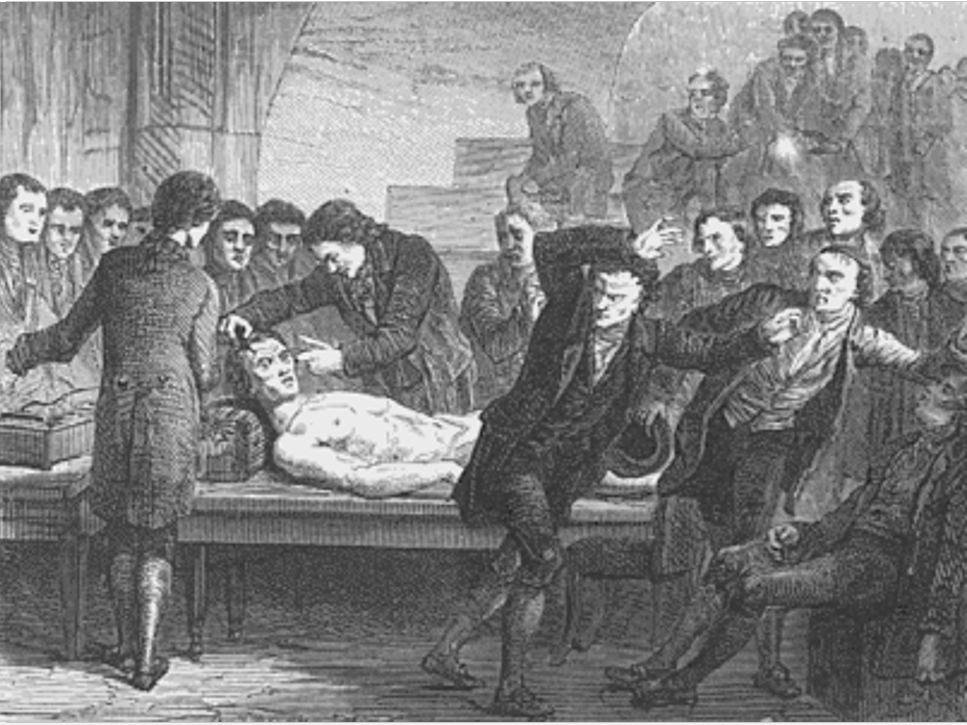
Farrar conveys a very detailed biography of Andrew Ure and emphasizes his many influential contributions to the scientific community. However, for the purposes of a presentation on the theory of galvanism and its connection to Mary Shelley’s Frankenstein, the paragraph that discusses Ure’s experiment in 1818 regarding the application of an electrical current to the cadaver of a recently executed criminal, Clydesdale, proves most pertinent. After connecting a “270-plate voltaic battery” to the exposed nerves of a dissected Clydesdale, Ure observed how the muscles in the cadaver’s face contorted into what appeared to be gruesome expressions, including smiles (307). Farrar also reveals that this public demonstration left many individuals terrified. Analogous to Agatha’s reaction after encountering Victor’s hideous creation in Shelley’s novel, Farrar discloses that a spectator fainted out of fear.
“Galvani, Luigi.” Complete Dictionary of Scientific Biography. Vol. 5. Detroit: Charles Scribner’s Sons, 2008. 267-69. Gale Virtual Reference Library [Gale].
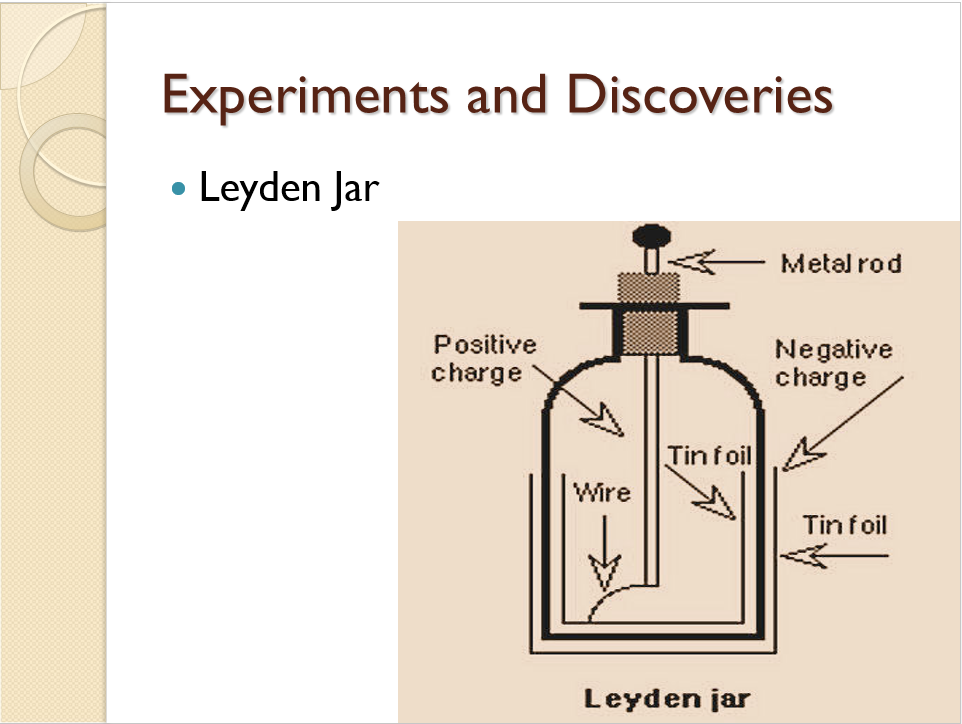
This excerpt from the Complete Dictionary of Scientific Biography begins with Galvani’s educational background. Studying medicine at the University of Bologna, Galvani became a skillful surgeon and anatomist. Shortly after turning his attention towards “more strictly physiological studies” and focusing his research towards the connections of an organism’s nerves and muscles, he made an unexpected discovery. During one of Galvani’s many frog dissections, a spark of static electricity caused a frog’s leg to convulse, leading him to believe that electricity played an influential role within an organism’s tissues. This source reveals the procedures by which Galvani conducted his experiments through the utilization of electric machines such as the Leyden jar, an electrostatic charged atmosphere, and different types of metals, conductors, and nonconductors. As a result, Galvani formulated his theory of animal electricity and became the pioneer of the concept of galvanism. Galvani believed that the frog’s internal tissues, nerves, and muscles produced electricity, emphasizing an animal’s internal possession of an “electric fluid.” However, this source also discusses Alessandro Volta’s opposition to Galvani’s proposition. Volta proposed that the electricity was created externally through contact of the leg with conducting metals. This idea led Volta to eventually development the first wet-cell battery.
Green, Thomas. “On Death From Chloroform: Its Prevention By Galvanism.” The British Medical Journal 1.595 (1872): 551-53.
Green’s descriptions of several medical cases involving the often fatal effects of early anesthetics, namely chloroform, conveys how developments in the theory of galvanism have greatly impacted and contributed to medical knowledge, technologies, and successes. A close examination of case outcomes involving both deaths and revivals reveals that galvanism has proven to be more effective than artificial respiration for its ability to restore animation, or movement, to a paralyzed and un-beating heart. Green also notes that patient outcomes are influenced by other elements, such as time. Although the application of a galvanic apparatus represents the most promising procedure, a patient’s revival depends on how fast the galvanic apparatus is administered after death.
Kemp, Martin. “Shelley’s Shocks.” Nature 394.6693 (1998): 529.
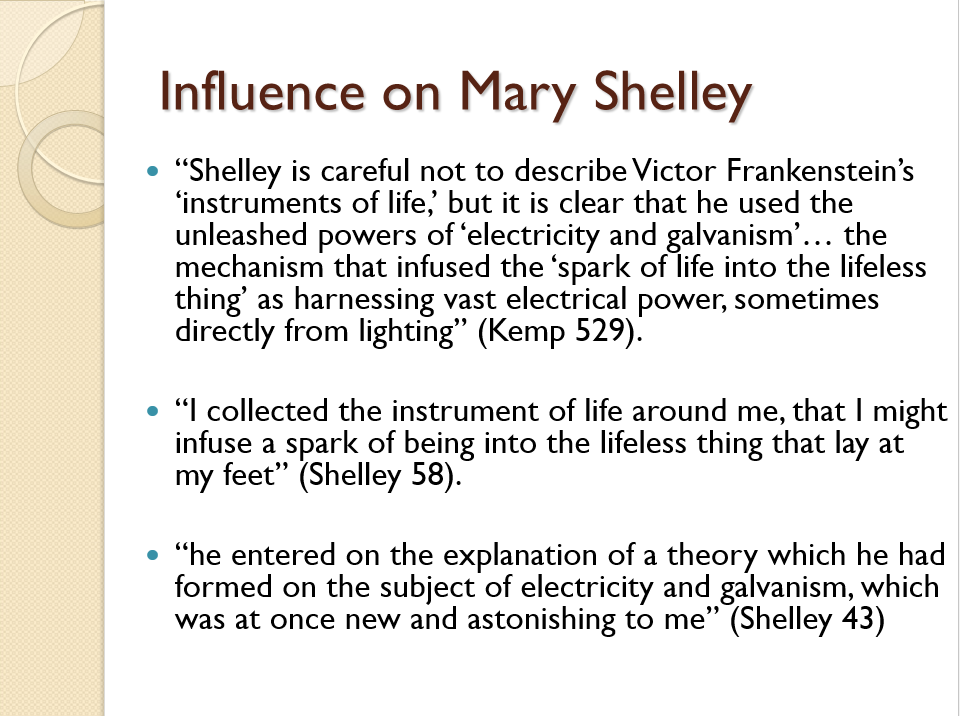
Kemp reveals that during the 18th century, scientific interests, research, and experiments were centered on the phenomenon of both electricity and the nature of life. As a result, Kemp discloses that Mary Shelley’s Frankenstein, published in 1818, symbolizes a direct product of these scientific theories and discoveries as disclosed through her allusion to galvanism and concept of reanimation. This article explains how the story of Frankenstein manifested itself to Shelley in a dream after a long discussion of several “philosophical doctrines,” including galvanism, with Lord Byron and Percy Shelley. Furthermore, this article provides a brief history regarding the discovery of galvanism by Luigi Galvani as well as describes its development over the years through experiments by Karl August Weinhold, Giovanni Aldini, and Andrew Ure.
Parent, André. “Giovanni Aldini (1762-1834).” Journal of Neurology 251.5 (2004): 637-38.
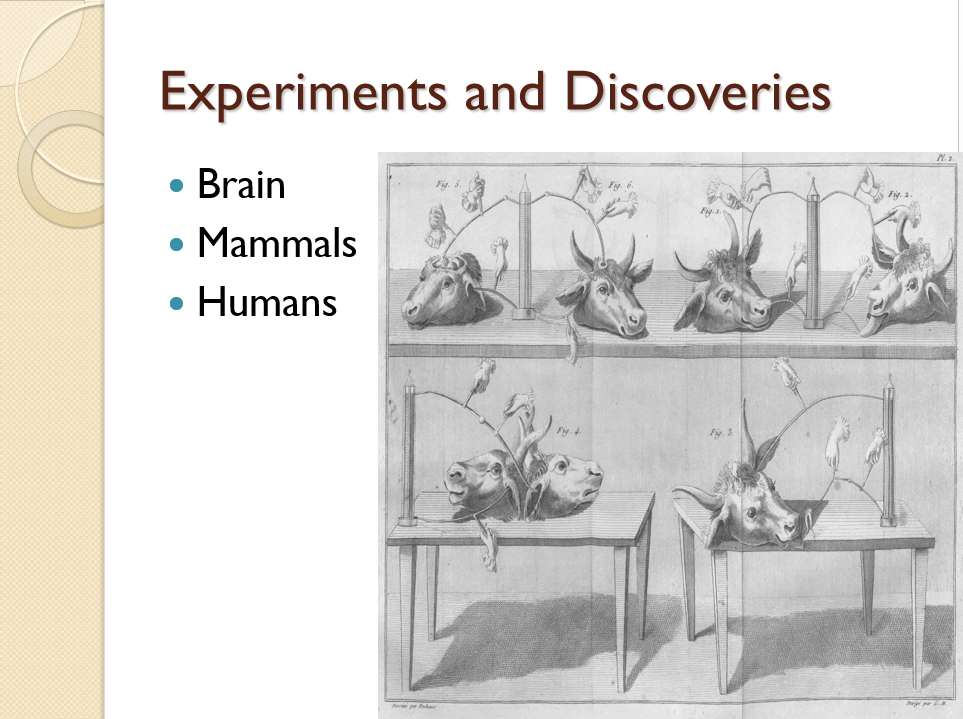
Parent discloses that Giovanni Aldini, Luigi Galvani’s nephew, followed in his uncle’s footsteps through an academic path devoted to science as well as an interest in the relationship between electricity and muscular movement. Aldini’s desire to further advance, support, and defend Galvani’s proposition of “animal electricity,” or galvanism, lead to the development of several new theories and experiments. Together, both Galvani and Aldini proposed that the brain, when stimulated, precipitates an electric current that causes a reactive response in the muscles throughout the entire body. Parent reveals that Aldini continued to conduct experiments after Galvani’s death. Aldini discovered that the activation of targeted areas of the brain cause specific muscles to contract while others remain at rest. Furthermore, Aldini expanded the subjects of his experiments to include mammals as well as frogs. Parent describes Aldini’s experiment on the human cadaver of a criminal in 1803 to be his “most famous demonstration.” Parent’s incorporation of the description of the cadaver’s vigorous convulsions as well as the opening of an eye reveals a potential influence on Mary Shelley’s inspiration for the pivotal creation scene in her novel, Frankenstein (1818).
Bordwell, David, and Kristin Thompson. Film Art: An Introduction. 10th ed. New York: McGraw Hill, 2013.
This textbook includes an entire section of a chapter devoted to the history of the horror genre, giving special attention to both the early German Expressionist films of the silent era as well as the classic Universal monster films. This portion pays particular attention to form, specifically the stylistic and compositional characteristics of these sorts of films. A later section of the book is used to explain the rise of German Expressionism not in the context of its genre, but in the cultural and socioeconomic conditions of Germany post WW1.
Edwards, Kyle. “Morals, Markets, and ‘Horror Pictures’: The Rise of Universal Pictures and the Hollywood Production Code.” Film & History: An Interdisciplinary Journal 42.2 (2012): 23-37.
This article focuses on three of Universal’s first horror movies and their correspondence with the Studio Relations Committee as the studio strove to create compelling stories while staying within the confines of the Hollywood Production Code. Frankenstein is highlighted to have been one of the first films to have push-back from censors on account of its “gruesome” content and ability to “instill ‘horror’ into a prospective audience.”
Roberts, Russell. “Frankenstein Films.” The Thirties in America. Ed. Tandy Lewis Thomas. 3 vols. Salem Press, 2011.
This article gives concise summaries of both Frankenstein (1931) and its first sequel, Bride of Frankenstein (1935). It notes how the successful first film helped save Universal Pictures from financial trouble and made stars out of many of its cast members. Both films are also analyzed for their similarities and differences, and their own impacts on the horror film genre.
Frankenstein’s monster is a very relatable character and I wanted to write a poem containing only questions about the monster’s creation, except for the last line, which is a command to Victor. Humanity always asks questions about the purpose of their existence and the meaning of life and I believe Shelley was mirroring this in her book. While reading Frankenstein, I felt as if this story could have been an epic poem about the rise and fall of a man who accomplished a remarkable feat but allowed the feat to consume him and all those closest to him. I really loved the idea of converting this to poetry that I decided to do this myself. I also wrote about my favorite part of the book, which is when Victor and his monster speak to each other for the first time. These moments of them together are so powerful that I wanted to sum them up in a small poem. The monster has only questions and wants acceptance from those around him. But don’t we all?
Why was I created?
For amusement?
Was I created out of boredom?
Can you not answer my questions?
Are you too afraid?
Do you think I will hurt you?
Can’t you see all I want are answers?
Isn’t that what everyone wants?
Do you not think I am only human doubting my existence?
Do you want me to end it all?
End you?
End me?
Did you know I could?
Did you know I could end you with a finger?
Are you ashamed?
What have I done to deserve this isolation?
This marginalization?
Is there in truth no beauty?
Is my appearance the deciding factor of my loneliness?
Are all humans so shallow?
Why do you insist on silence, Creator?
Can you not see you are my only god?
Do you want to be my only god?
Is this too much for you to handle?
Look at me!
“And now, dear Margaret, do I not deserve to accomplish some great purpose?”
The first volume of Mary Shelley’s Frankenstein takes the viewpoint of Robert Walton and Victor Frankenstein, two different men but eerily similar in their desire for glory. Robert seeks fame in geographical exploration while Victor dedicates himself to scientific discovery. Although they start their goals with enough ability, their journeys become fraught with hardship. By turning unbridled ambition into unexpected consequences, the author points out the problem of male hubris.
Coming from similar pasts, both of the male characters have tried to display their importance to the world. In his early years, Robert studied day and night, set his eyes on voyage, and dedicated [himself] to this “great enterprise.” Robert believes that he will bring “inestimable benefit” by discovering the passage near the North Pole and writes that “success shall crown my endeavors.” The constant use of “mine” and “I” in the letters reaffirm his extreme self-confidence. Similarly, Victor often refers to his own abilities as he states, “myself capable of bestowing animation upon lifeless matter.” Like Robert, Victor also had studied for “days and nights of incredible fatigue.” From isolation to ego, Shelley shows how the characters’ desire for attention blinds them to the consequences of their own actions.
For Victor, his downfall was apparent. The story he tells to Robert is filled with instances of dedicating, achieving, and pursuing the impossible. Yet, tied up in the glory, his final creation had only caused woe to his family through “the work of [his] thrice-accursed hands.” In the letters, Robert states that his dangers were only minor. However, the reader has a limited perspective. It is possible that since he jokes about the “evil forebodings” said by his sister, Robert is diminishing the problems he encountered throughout his journey. Still, according to him, Robert had spent six years since his undertaking and “voluntarily endured cold, famine, thirst, and want of sleep,” which shows that he had suffered terribly for his pursuits.
While characters such as Justine could be called weak-willed, Shelley’s portrayal of Victor and Robert show that the the men, too, face problems of their own doing. In Frankenstein, Robert and Victor lead the story, but their egos make them fallible.
I got the inspiration for “The Sapling” from volume one of Mary Shelley’s “Frankenstein”. In my poem, the sapling represents Victor Frankenstein. I wanted to illustrate the image of Victor as an innocent young person before he becomes interested in metaphysical science. The old trees in the poem represent the scientists that Victor becomes obsessed with into his youth such as Cornelius Agrippa, Paracelsus, and Albertus Magnus. Though no one else thinks these scientists are worthy of time or study, just as no one thinks the old trees’ fruit is sweet enough to eat, Victor and the sapling still hold onto them. The growth of the fruit on the sapling is meant to represent the work that Victor puts into the reanimation of the creature. Though Victor thinks that his creation will be this wonderful thing that will change the world for the better, it turns out to be a frightening (and possibly murderous) monster, just as the apples of the sapling look ripe but are terribly rotten (and possibly poisonous).
In the center of the garden
grew a sapling, never after forgotten.
Summers came, and Winters passed,
through many years this tree did last.
Its roots grew deeper and entangled
roots of trees no longer able
to bear fruit of ample sweetness
to attract one’s tongue to witness.
The old trees spread this malady
through their roots to the young sapling.
As those old trees withered down,
the young tree’s branches were abound
with the blossoms that preceded
the growth of apples, unimpeded.
Though the fruits appeared so red,
the inside filled each taster with dread.
There was no sweetness, only a bitter,
toxic, and pernicious flavor.
Worse than the flavor, was the sight
of fruit’s flesh that was black as night.
Though promising this sapling was,
its fruit has broken nature’s laws.
No more seasons came to pass
before the sapling was replaced by grass.
Intertwined within the narrative of the first volume of Frankenstein, the title character constantly experiences moral dilemma as a result of his actions. The whole story being told in retrospect makes the reader aware that, in the present, Frankenstein fully understands the destruction that he and his creation caused and in the time leading up to and following these events, he considered the factors that saw them to completion. However, what Shelley doesn’t make quite clear through this story-telling technique is that Frankenstein considers himself fully responsible.
In the 1831 revision of Frankenstein, Shelley strays from the idea that the doctor himself, and any underlying corruption of morality on his part were to blame for the evil he ended up creating. In this way, Frankenstein’s creation is instead the result of a confluence of predispositions that could have influenced anyone with Frankenstein’s interest in science and life history to have completed the same action and have arrived at the same result.
It seems that with each misfortune along this timeline that Frankenstein describes, he’s compelled to send a shoutout to fate for being the reason they were ultimately unavoidable. When his mother dies, he calls the death an “omen of future misery,” owing to his ensuing preoccupation with death. Even to seemingly ordinary elements of his personality he assigns a great significance over what happened in his future (i.e. his passion for science), but blames fate and destiny for being the reasons that he couldn’t stop himself from following a path that would lead him to creating the monster.
In some instances, Shelley’s preoccupation with the idea of an unchanging fate serves on a somewhat shallow level as fuel for the movement of the plot, in that some events are written-in solely so that Frankenstein will eventually find himself at a place where his decision to create the monster seems like the only available one. In this way, fate is a force that seals itself, regardless of Frankenstein’s say in the matter. On another level, Frankenstein’s continual accusation of fate redirects any discussion of his morality for the characters in the book and supposedly also for Shelley. In reality however, such an argument might not hold the same ground.
When Robert Walton rescues Victor Frankenstein from the freezing Arctic waters, Frankenstein immediately faints and needs to be “re-animated” with a small amount of brandy (Shelley 26-7). Once he recovers, Walton takes care of him and treats him kindly even though “his eyes have generally an expression of wildness, even madness” and “he gnashes his teeth” (27). Walton is able to see “benevolence and sweetness” (27) in him and begins to “love him as a brother” (28), even though he barely knows him at all.
In contrast, when Frankenstein gives life to his creation, he is immediately horrified and abandons it in his laboratory (58). He is disgusted by the creation’s physical appearance, even though he picked each piece of it himself (58). He doesn’t even try to talk to or understand the thing to whom he has given life. In fact, the creature opens his mouth and may have been trying to talk to him, but he is not listening (59).
It could be that once a person has, like Frankenstein, attained the unthinkable and unnatural — the sublime — they are unable to reconcile with their own humanity. By laboring obsessively and neglecting correspondence with his family (55-7) Frankenstein has become alienated from humanity and become purely a vessel for science. Frankenstein refers to this state as a madness (29), and attempts to prevent Walton from pursuing a similar path of passionate scientific endeavor (29).
Frankenstein perceives himself as having created something monstrous which originally seemed only beautiful until he reflected on his work (58). This is all too apt a metaphor for the life he has created for himself over the 2 years he obsessed over his re-animation project. When Frankenstein says that “breathless horror and disgust filled [his] heart,” this is as a result of his deprivation of rest and health (58). He has become a monster in his narrow-sightedness and is desperately trying to stop the creation of another monster (of Robert Walton) by relaying his tragic story.
 (Oc)Cult Classics