Victor Frankenstein and the Art of Subterfuge

There was a passage at the tail end of the third chapter of volume three that shed a particular light on the storytelling methods of Victor Frankenstein. On page 175, right after he’s destroyed the female half-creature, Victor gives his audience (Walton) an assessment of his situation: “I had resolved in my own mind, that to create another like the fiend I had first made would be an act of the basest and most atrocious selfishness.” This statement serves to complicate interpretations of Frankenstein’s moral leanings throughout Shelley’s novel. Throughout the course of his wanderings, Victor has made it evident that his family is not necessarily a top priority. He abandons his house for years at a time, returning to Geneva in times of grief to indulge in his reclusiveness in the company of his family, then fleeing again. When he does exhibit concern for them, it is directly related to their proximity to creature-induced danger. Victor and his creature are at the epicenter of his focus; everything else falls away in importance by orders of magnitude. He emotes this very clearly and lengthily on page 90 of the novel.

The fact that the story is told by Frankenstein automatically puts the reader at a disadvantage in respect to authenticity. What this particular line does is demonstrate Victor’s attempts to undermine some of his accountability for the creation of the monster and cast himself in a more noble light. Returning to his selfishness outlined previously, the interpretation of egotism comes from the same chapter as the quotation. In the first two pages of chapter three, Frankenstein ruminates on all the possible ways that the two creations could/would wreak havoc on the world, and in doing so strips the monster(s) of all of their autonomy and places himself in knowing superiority over them. His ego feeds into his hatred and solidifies his abandonment of his task, and when he comes to rationalizing away his decision, he flips the logic of his dilemma in a way that seems reasonable at face value. Going back to the quote, we see that Victor treats the fulfillment of his promise to his creation as the ultimate selfishness; how can this be so, when we’ve seen so much of the pain of the creature and the danger he poses to Victor and his own family? It would make sense to the reader that creating two of these “monsters” in order to secure safety would be selfish, but Victor’s denial of his creation’s capacity for compassion/reason/civility as part of his justification for this idea continues to strengthen the guiding hand Victor has on the reader’s interpretation of his own virtuosity.

The Master and the Slave

VF

In Chapter 1 of Volume III, on pages 157 and 158, Victor refers to his predicament as his “slavery”. I already thought that was an interesting concept until, not accidentally, the creation later (when lamenting over Frankenstein’s body) refers to itself as a “slave, not the master” (p.222).

I realized Shelley was perhaps trying to say something here. So, I started thinking about how she framed the distinct parallels between the creator and the creation:

Victor

VFKB

A scientist haunted by a creature of his own design. He doesn’t understand what he has made, or the power he wields, and it is his downfall. A seemingly complex character, he is really quite shallow and one-dimensional; with all his good intentions, he does not think of the consequences of his actions (like just abandoning the creation OR like sending Elizabeth upstairs alone on their wedding night… HELLO?!). He expunges his energy into making the creature only to abandon it the moment the spark of life appears – realizing too late what he had done. The only attempt at civility with or understanding the creature is when it regales its side of the story – in a brief moment of clarity, even Victor realizes that what the creation asks for is not unreasonable. But certainly, after what had taken place at this point, it was normal for him to be suspicious. However, not taking responsibility for his actions ultimately leads to his entire bloodline being wiped out.

The creation

fmeme

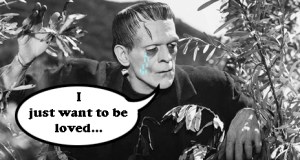
Abandoned at birth for reasons it didn’t understand, it was forced to learn the ways of the world alone only to be shunned by humans. Upon hearing its side of the story in Volume II, the reader cannot help but to feel sympathetic for the creation (especially with the loss of the French family he had hoped to call friends). He is lonely, and there is not much else in the world that can make one more miserable. Its gruesome looks make it impossible for him to be near humanity and its superficiality. It realizes inner beauty is useless and that’s all it has. A mate, created equal, is its only hope. Think of the creation like a child; in the simplest terms, he threw a tantrum when Victor destroys the second creation and exacts un-ending revenge until Frankenstein’s demise.

 The Second Creation (Hypothetically)

bride

It was never brought up verbally whether or not the second creation would even have reacted favorably to the union. Frankenstein surmises briefly at what her reaction might be at the beginning of Chapter 3, Volume 3. I think it could have been a real argument for Victor not to make it; the creature, unless angry, seems reasonable. If the second creation had come into existence, a whole other dynamic of master and slave could arguably be drawn. The second creation would be a slave to the first – existing only to satiate his needs. The possibility of ever separating from him seems low.  If it were to be created the same as the first, would it not have consciousness and the ability to think for itself? What if it did not want that? What if, being equally miserable, it asked Victor for the same thing, being unhappy with the first creation? The creature would have most certainly reacted unfavorably to this outcome and then where would Victor be? To me, this was a realistic cyclical possibility that was only briefly addressed.

VFC

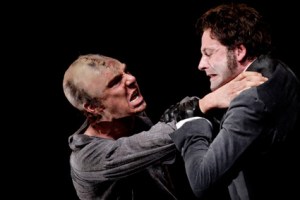
Once the master creator, Frankenstein now sees the creation as his master, forcing him into making a mate; Interestingly, the creature always sees Victor as his master, the only one capable of making him happy. They depend on each other but are fueled by too many emotions and too much misery to see it.

Frankenstein: Galvanism (oalandry and tylynn9)

Farrar, W. V. “Andrew Ure, F.R.S., and the Philosophy of Manufactures.” Notes and Records of the Royal Society of London 27.2 (1973): 299-324.

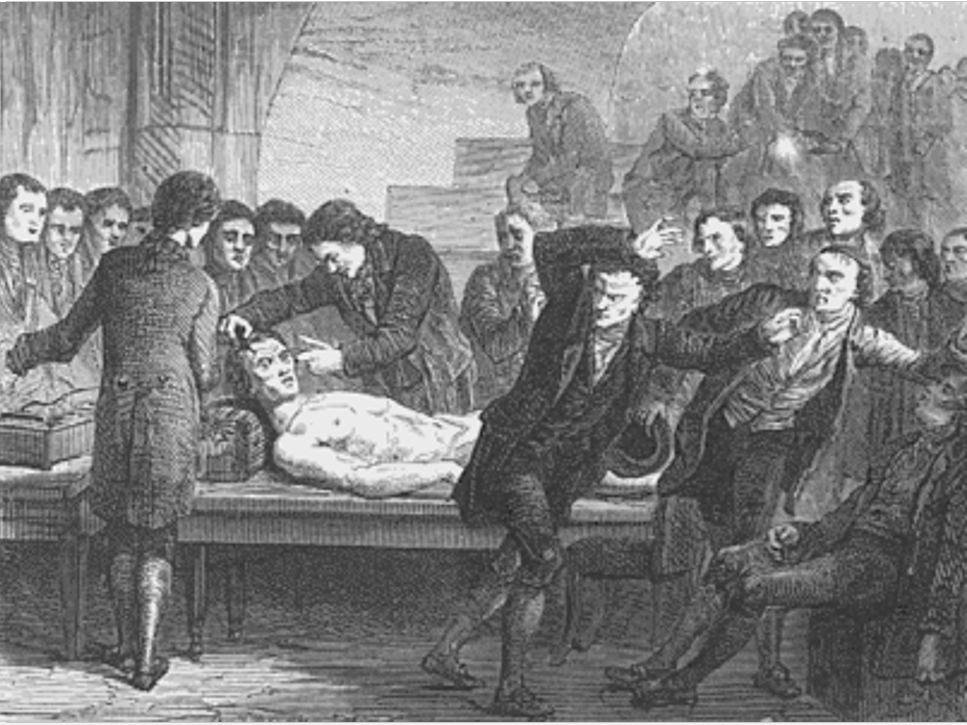
Farrar conveys a very detailed biography of Andrew Ure and emphasizes his many influential contributions to the scientific community. However, for the purposes of a presentation on the theory of galvanism and its connection to Mary Shelley’s Frankenstein, the paragraph that discusses Ure’s experiment in 1818 regarding the application of an electrical current to the cadaver of a recently executed criminal, Clydesdale, proves most pertinent. After connecting a “270-plate voltaic battery” to the exposed nerves of a dissected Clydesdale, Ure observed how the muscles in the cadaver’s face contorted into what appeared to be gruesome expressions, including smiles (307). Farrar also reveals that this public demonstration left many individuals terrified. Analogous to Agatha’s reaction after encountering Victor’s hideous creation in Shelley’s novel, Farrar discloses that a spectator fainted out of fear.

“Galvani, Luigi.” Complete Dictionary of Scientific Biography. Vol. 5. Detroit: Charles Scribner’s Sons, 2008. 267-69. Gale Virtual Reference Library [Gale].

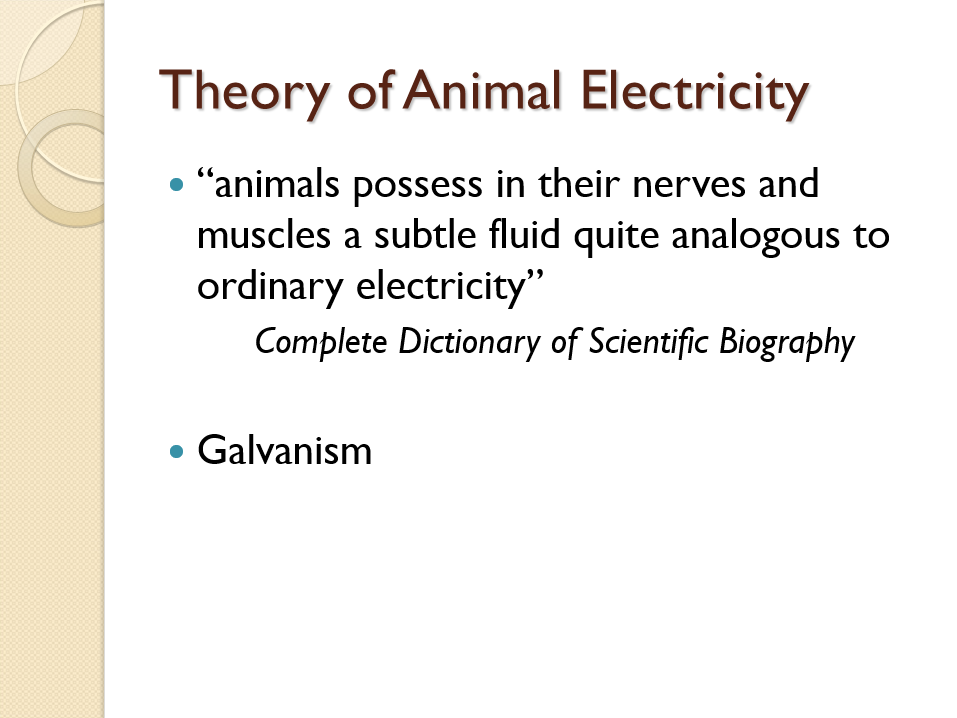
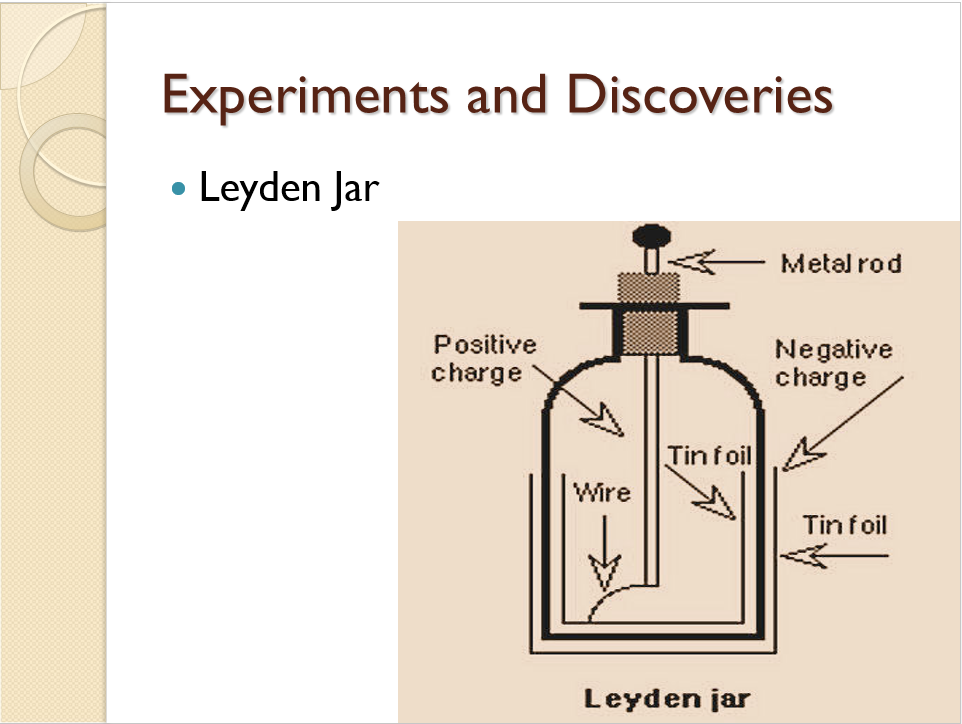
This excerpt from the Complete Dictionary of Scientific Biography begins with Galvani’s educational background. Studying medicine at the University of Bologna, Galvani became a skillful surgeon and anatomist. Shortly after turning his attention towards “more strictly physiological studies” and focusing his research towards the connections of an organism’s nerves and muscles, he made an unexpected discovery. During one of Galvani’s many frog dissections, a spark of static electricity caused a frog’s leg to convulse, leading him to believe that electricity played an influential role within an organism’s tissues. This source reveals the procedures by which Galvani conducted his experiments through the utilization of electric machines such as the Leyden jar, an electrostatic charged atmosphere, and different types of metals, conductors, and nonconductors. As a result, Galvani formulated his theory of animal electricity and became the pioneer of the concept of galvanism. Galvani believed that the frog’s internal tissues, nerves, and muscles produced electricity, emphasizing an animal’s internal possession of an “electric fluid.” However, this source also discusses Alessandro Volta’s opposition to Galvani’s proposition. Volta proposed that the electricity was created externally through contact of the leg with conducting metals. This idea led Volta to eventually development the first wet-cell battery.

Green, Thomas. “On Death From Chloroform: Its Prevention By Galvanism.” The British Medical Journal 1.595 (1872): 551-53.

Green’s descriptions of several medical cases involving the often fatal effects of early anesthetics, namely chloroform, conveys how developments in the theory of galvanism have greatly impacted and contributed to medical knowledge, technologies, and successes. A close examination of case outcomes involving both deaths and revivals reveals that galvanism has proven to be more effective than artificial respiration for its ability to restore animation, or movement, to a paralyzed and un-beating heart. Green also notes that patient outcomes are influenced by other elements, such as time. Although the application of a galvanic apparatus represents the most promising procedure, a patient’s revival depends on how fast the galvanic apparatus is administered after death.

Kemp, Martin. “Shelley’s Shocks.” Nature 394.6693 (1998): 529.

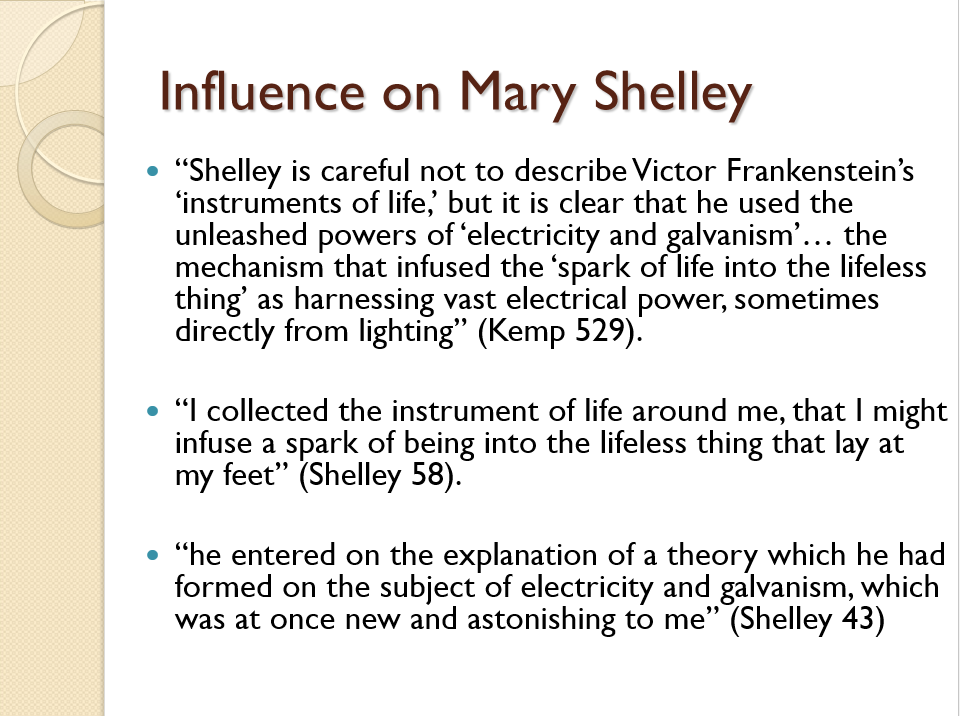
Kemp reveals that during the 18th century, scientific interests, research, and experiments were centered on the phenomenon of both electricity and the nature of life. As a result, Kemp discloses that Mary Shelley’s Frankenstein, published in 1818, symbolizes a direct product of these scientific theories and discoveries as disclosed through her allusion to galvanism and concept of reanimation. This article explains how the story of Frankenstein manifested itself to Shelley in a dream after a long discussion of several “philosophical doctrines,” including galvanism, with Lord Byron and Percy Shelley. Furthermore, this article provides a brief history regarding the discovery of galvanism by Luigi Galvani as well as describes its development over the years through experiments by Karl August Weinhold, Giovanni Aldini, and Andrew Ure.

Parent, André. “Giovanni Aldini (1762-1834).” Journal of Neurology 251.5 (2004): 637-38.

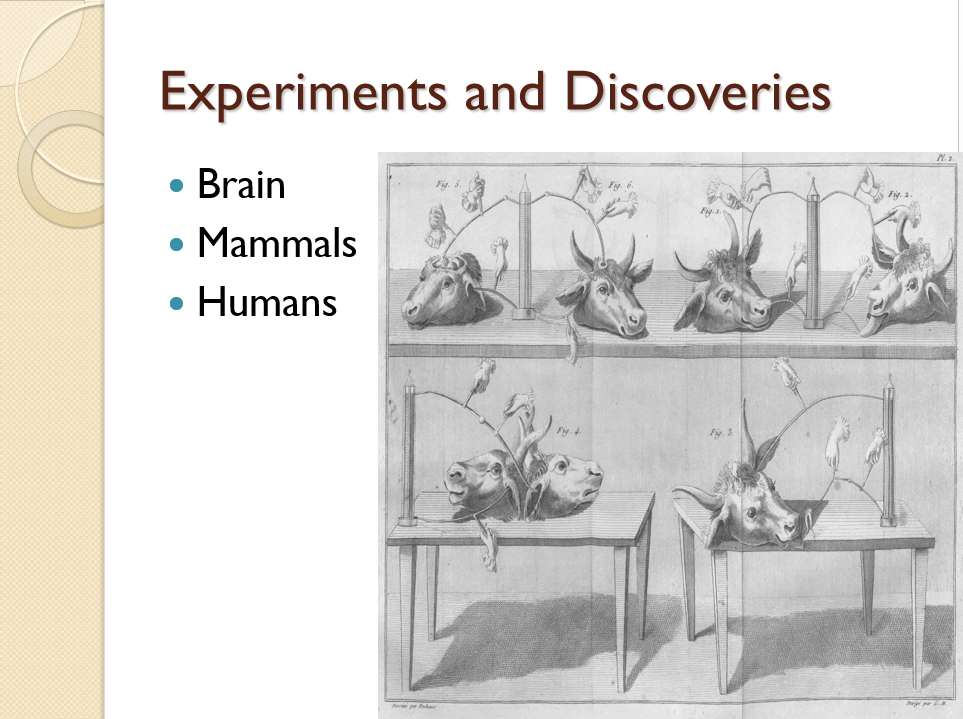
Parent discloses that Giovanni Aldini, Luigi Galvani’s nephew, followed in his uncle’s footsteps through an academic path devoted to science as well as an interest in the relationship between electricity and muscular movement. Aldini’s desire to further advance, support, and defend Galvani’s proposition of “animal electricity,” or galvanism, lead to the development of several new theories and experiments. Together, both Galvani and Aldini proposed that the brain, when stimulated, precipitates an electric current that causes a reactive response in the muscles throughout the entire body. Parent reveals that Aldini continued to conduct experiments after Galvani’s death. Aldini discovered that the activation of targeted areas of the brain cause specific muscles to contract while others remain at rest. Furthermore, Aldini expanded the subjects of his experiments to include mammals as well as frogs. Parent describes Aldini’s experiment on the human cadaver of a criminal in 1803 to be his “most famous demonstration.” Parent’s incorporation of the description of the cadaver’s vigorous convulsions as well as the opening of an eye reveals a potential influence on Mary Shelley’s inspiration for the pivotal creation scene in her novel, Frankenstein (1818).
Frankenstein: Film adaptions (mmwilliams1 and spencerj123)

Bordwell, David, and Kristin Thompson. Film Art: An Introduction. 10th ed. New York:   McGraw Hill, 2013.

This textbook includes an entire section of a chapter devoted to the history of the horror genre, giving special attention to both the early German Expressionist films of the silent era as well as the classic Universal monster films. This portion pays particular attention to form, specifically the stylistic and compositional characteristics of these sorts of films. A later section of the book is used to explain the rise of German Expressionism not in the context of its genre, but in the cultural and socioeconomic conditions of Germany post WW1.

Edwards, Kyle. “Morals, Markets, and ‘Horror Pictures’: The Rise of Universal Pictures and the Hollywood Production Code.” Film & History: An Interdisciplinary Journal 42.2 (2012): 23-37.

This article focuses on three of Universal’s first horror movies and their correspondence with the Studio Relations Committee as the studio strove to create compelling stories while staying within the confines of the Hollywood Production Code. Frankenstein is highlighted to have been one of the first films to have push-back from censors on account of its “gruesome” content and ability to “instill ‘horror’ into a prospective audience.”

Roberts, Russell. “Frankenstein Films.” The Thirties in America. Ed. Tandy Lewis Thomas. 3 vols. Salem Press, 2011.

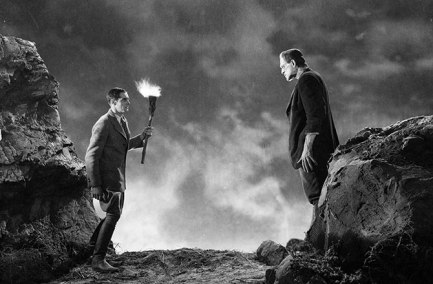
This article gives concise summaries of both Frankenstein (1931) and its first sequel, Bride of Frankenstein (1935). It notes how the successful first film helped save Universal Pictures from financial trouble and made stars out of many of its cast members. Both films are also analyzed for their similarities and differences, and their own impacts on the horror film genre.

Look at me! – Explanation Post

Frankenstein’s monster is a very relatable character and I wanted to write a poem containing only questions about the monster’s creation, except for the last line, which is a command to Victor. Humanity always asks questions about the purpose of their existence and the meaning of life and I believe Shelley was mirroring this in her book. While reading Frankenstein, I felt as if this story could have been an epic poem about the rise and fall of a man who accomplished a remarkable feat but allowed the feat to consume him and all those closest to him. I really loved the idea of converting this to poetry that I decided to do this myself. I also wrote about my favorite part of the book, which is when Victor and his monster speak to each other for the first time. These moments of them together are so powerful that I wanted to sum them up in a small poem. The monster has only questions and wants acceptance from those around him. But don’t we all?

Look at me!

Why was I created?

For amusement?

Was I created out of boredom?

Can you not answer my questions?

Are you too afraid?

Do you think I will hurt you?

Can’t you see all I want are answers?

Isn’t that what everyone wants?

Do you not think I am only human doubting my existence?

Do you want me to end it all?

End you?

End me?

Did you know I could?

Did you know I could end you with a finger?

Are you ashamed?

What have I done to deserve this isolation?

This marginalization?

Is there in truth no beauty?

Is my appearance the deciding factor of my loneliness?

Are all humans so shallow?

Why do you insist on silence, Creator?

Can you not see you are my only god?

Do you want to be my only god?

Is this too much for you to handle?

Look at me!

Beast of Burden

tavern

In Emily Carroll’s digital comic “His Face All Read” the reader is presented with a story of the narrator’s guilt and paranoia when his brother returns to their town 3 days after he was killed. The brother had been murdered by the narrator after he killed a mysterious beast plaguing the town’s animals. The brother never finds out what exactly happened to the beast or his brother, though evidence in the text signals that the beast had taken the form of the brother.

The actual killing of the brother is not seen, the act is shown with a landscape shot with a red filter. Because the death of the brother is not explicitly seen raises the suspicion that he was not killed when the narrator presumably shot him. The brother was “killed” by the narrator (his face all red with blood), but given the narrator’s look of cowardice for most of the comic, there are indications that he has little experience with firearms. This leads to the idea that he may not have killed his brother when he shot him, only fatally wounding him. The 3 day gap from the woods incident to the return of the brother is intentionally left open to interpretation, but given more textual support the reader could construe the newly returned brother to be the beast.

If one assumes the beast is not just a wolf, and possibly a shape shifting creature, it is plausible to believe that the beast could have taken the form of the brother after the incident, arrived back into town, and assumed the role of the narrator’s brother. Though the logistics are not entirely laid out, I believe this is the case when the brother’s coat is considered.

When the narrator goes home from the woods he takes a torn, blood soaked piece of the brother’s coat with him, yet when the brother returns the coat appears brand new. No one but the reader and the narrator catch onto this detail, “And I was the only one who noticed…his fine coat, it wasn’t torn.” If the beast had somehow taken the form of the brother, and tried to recreate him, then the coat would have been re constructed as well.

The vagueness of the writing, and the omission of scenes shown to the reader are intentionally left open to interpretation, part of the atmospheric horror that the comic strives to make the reader feel comes entirely from the reader’s imagination. When one takes into account small details scattered throughout the story it is clear that fan theories, when formulated with enough evidence, are endless when it comes to the fate of the brother. In reading the comic, I found that the only reason I could give for the brother’s return was the beast’s acquisition of the brother’s form.

In Sheep’s Clothes – Explanation

“In Sheep’s Clothes” was inspired by Emily Carroll’s style, specifically from “His Face All Red” and “Margot’s Room”. The idea of a narrator who can’t quite be trusted, who may know a horrible truth or simply be out of their mind. This idea is seen throughout Emily’s works, notably in “Margot’s Room” as the mother sees her husband as some sort of monster. However, it is left to the reader to decide whether or not they believe that he is truly the beast depicted or if the narrator has simply succumbed to grief and madness. The idea of a town thrown into chaos at the hands of a “beast” is inspired by “His Face All Red”. The writing style in general, most obviously the heavy use of repetition and shorter sentences, is also inspired by Emily and her work. The hope was to progressively instill a sense of dread into the reader as they see the narrator’s supposed insanity and his descent into madness as he begins his hunt of the “beast”.

The Male Ego in Frankenstein

“And now, dear Margaret, do I not deserve to accomplish some great purpose?”

The first volume of Mary Shelley’s Frankenstein takes the viewpoint of Robert Walton and Victor Frankenstein, two different men but eerily similar in their desire for glory. Robert seeks fame in geographical exploration while Victor dedicates himself to scientific discovery. Although they start their goals with enough ability, their journeys become fraught with hardship. By turning unbridled ambition into unexpected consequences, the author points out the problem of male hubris.

Coming from similar pasts, both of the male characters have tried to display their importance to the world. In his early years, Robert studied day and night, set his eyes on voyage, and dedicated [himself] to this “great enterprise.” Robert believes that he will bring “inestimable benefit” by discovering the passage near the North Pole and writes that “success shall crown my endeavors.” The constant use of “mine” and “I” in the letters reaffirm his extreme self-confidence. Similarly, Victor often refers to his own abilities as he states, “myself capable of bestowing animation upon lifeless matter.” Like Robert, Victor also had studied for “days and nights of incredible fatigue.” From isolation to ego, Shelley shows how the characters’ desire for attention blinds them to the consequences of their own actions.

For Victor, his downfall was apparent. The story he tells to Robert is filled with instances of dedicating, achieving, and pursuing the impossible. Yet, tied up in the glory, his final creation had only caused woe to his family through “the work of [his] thrice-accursed hands.” In the letters, Robert states that his dangers were only minor. However, the reader has a limited perspective. It is possible that since he jokes about the “evil forebodings” said by his sister, Robert is diminishing the problems he encountered throughout his journey. Still, according to him, Robert had spent six years since his undertaking and “voluntarily endured cold, famine, thirst, and want of sleep,” which shows that he had suffered terribly for his pursuits.

While characters such as Justine could be called weak-willed, Shelley’s portrayal of Victor and Robert show that the the men, too, face problems of their own doing. In Frankenstein, Robert and Victor lead the story, but their egos make them fallible.