Jealousy and Delirium in His Face All Red–An Analysis

Emily Carroll’s web-comic, His Face All Red, focuses on two main characters—the Narrator and his Brother. Neither is named in the story, therefore I have capitalized their titles for referencing purposes.

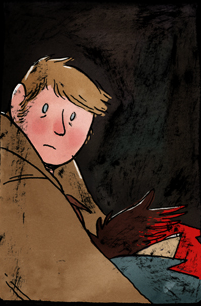
The Narrator immediately builds sympathy for the Brother by describing him as handsome and trustworthy, while painting himself as envious and unpopular. Due to an unreliable narrator, the only thing I can tell for certain what is true are his emotions, as his story may have untruthful elements pertaining to events and appearances. For example, it is not clear if when the characters pass by a tree and stream whether the descriptions are simple similaic descriptors, or if the trees and streams in this fictional world actually look and sound like that.

After the Narrator kills the Brother, he is celebrated for slaying the beast that was terrorizing the village and is given his Brother’s animals. He seems content here, as he notes he dreamt of nothing. One part of the story is that the Narrator is the only one who notices the Brother’s coat is not missing the piece he ripped from it. If the Narrator really did take a piece and show it to the townspeople for proof of his Brother’s death, why then was he the only one who noticed? I suppose everyone could have been too overcome with joy to notice for themselves. This is peculiar nonetheless.

The Narrator seeing the Brother at night digging could be a hallucination or an actual event, but at this point in the story he is just as confused as the reader, if not more so due to him not being entirely normal/sane at the beginning.

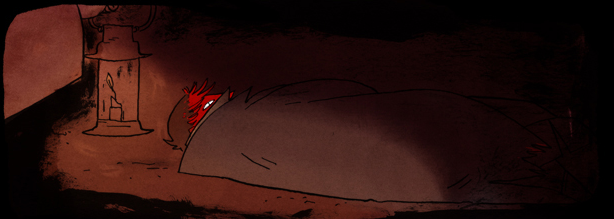
In the hole the Brother was deposited into, the Narrator comes across a body. Personally, it was hard for me to tell if it was the Brother’s or not as all that was shown was some hair and an eye (and the outline of his jacket I suppose). It is possible that it could be the Brother: the Narrator had just finished asking why the Brother who had come back does not look at him, implying his Brother usually does. The eye shown looking at the Narrator in the final scene could be a reference to that. It could possibly be any sort of dead body. What the Narrator finds may not even be real; he could be imagining whoever/whatever he found down in that hole, as his mind is clearly not in the best shape.
Fate in Frankenstein

Intertwined within the narrative of the first volume of Frankenstein, the title character constantly experiences moral dilemma as a result of his actions. The whole story being told in retrospect makes the reader aware that, in the present, Frankenstein fully understands the destruction that he and his creation caused and in the time leading up to and following these events, he considered the factors that saw them to completion. However, what Shelley doesn’t make quite clear through this story-telling technique is that Frankenstein considers himself fully responsible.

In the 1831 revision of Frankenstein, Shelley strays from the idea that the doctor himself, and any underlying corruption of morality on his part were to blame for the evil he ended up creating. In this way, Frankenstein’s creation is instead the result of a confluence of predispositions that could have influenced anyone with Frankenstein’s interest in science and life history to have completed the same action and have arrived at the same result.

It seems that with each misfortune along this timeline that Frankenstein describes, he’s compelled to send a shoutout to fate for being the reason they were ultimately unavoidable. When his mother dies, he calls the death an “omen of future misery,” owing to his ensuing preoccupation with death. Even to seemingly ordinary elements of his personality he assigns a great significance over what happened in his future (i.e. his passion for science), but blames fate and destiny for being the reasons that he couldn’t stop himself from following a path that would lead him to creating the monster.

In some instances, Shelley’s preoccupation with the idea of an unchanging fate serves on a somewhat shallow level as fuel for the movement of the plot, in that some events are written-in solely so that Frankenstein will eventually find himself at a place where his decision to create the monster seems like the only available one. In this way, fate is a force that seals itself, regardless of Frankenstein’s say in the matter. On another level, Frankenstein’s continual accusation of fate redirects any discussion of his morality for the characters in the book and supposedly also for Shelley. In reality however, such an argument might not hold the same ground.

Frankenstein the Monster

When Robert Walton rescues Victor Frankenstein from the freezing Arctic waters, Frankenstein immediately faints and needs to be “re-animated” with a small amount of brandy (Shelley 26-7). Once he recovers, Walton takes care of him and treats him kindly even though “his eyes have generally an expression of wildness, even madness” and “he gnashes his teeth” (27). Walton is able to see “benevolence and sweetness” (27) in him and begins to “love him as a brother” (28), even though he barely knows him at all.

In contrast, when Frankenstein gives life to his creation, he is immediately horrified and abandons it in his laboratory (58). He is disgusted by the creation’s physical appearance, even though he picked each piece of it himself (58). He doesn’t even try to talk to or understand the thing to whom he has given life. In fact, the creature opens his mouth and may have been trying to talk to him, but he is not listening (59).

It could be that once a person has, like Frankenstein, attained the unthinkable and unnatural — the sublime — they are unable to reconcile with their own humanity. By laboring obsessively and neglecting correspondence with his family (55-7) Frankenstein has become alienated from humanity and become purely a vessel for science. Frankenstein refers to this state as a madness (29), and attempts to prevent Walton from pursuing a similar path of passionate scientific endeavor (29).

Frankenstein perceives himself as having created something monstrous which originally seemed only beautiful until he reflected on his work (58). This is all too apt a metaphor for the life he has created for himself over the 2 years he obsessed over his re-animation project. When Frankenstein says that “breathless horror and disgust filled [his] heart,” this is as a result of his deprivation of rest and health (58). He has become a monster in his narrow-sightedness and is desperately trying to stop the creation of another monster (of Robert Walton) by relaying his tragic story.

Monster vs. Brother: Color and Other Recurring Narrative Strategies

Cult Classics Blog Post 1 Corrections

One of the most intriguing mysteries readers may find themselves pondering while reading “His Face All Red” is the ambiguity surrounding when the murdered brother is the beast, and when he is himself. Emily Caroll uses a number of storytelling devices to facilitate this narrative vagueness including recurring phrases, color selection, and the specific placement of visual indicators.

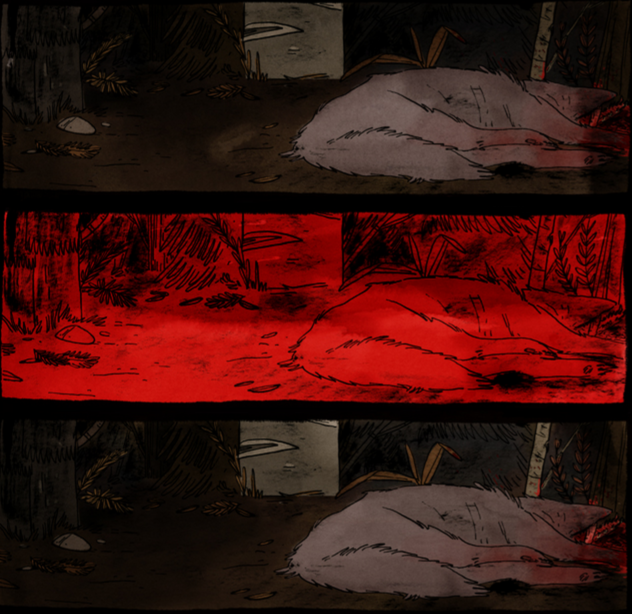
The poem opens with a dark-red tint coloring the image in the panel. It is revealed to us that this is not the narrator’s brother, and that he had killed his actual brother. We cut to see a goat, a victim of the beast, covered in blood, another occurrence of red. The narrative flashes back to reveal information about the town and the characters, establishing that the narrator is feeble and the brother has all he desires. In referencing the beast’s emergence from the woods, the narrator claims in a parenthetical aside “most strange things do.” Following that, the narrator and his brother go into the woods to hunt the beast. When they locate it, the narrator hides while the brother confronts the wolf off-panel. This is when the dark-red panel shading returns for the first time since flashing back, flooding a panel while the brother kills “the beast,” which turned out to only be a wolf. The dark-red hue returns once again when the narrator makes another parenthetical aside to claim that the villagers would only be grateful “to him (brother).” There is another red flash as the narrator murders his brother off panel. He emerges from the wood, dragging his brother’s corpse behind him with his face covered in blood. This is an occurrence of the dark-red color existing inside the narrative of the piece. The narrator returns home a hero and comfortably slips into a guilt free routine, until his brother emerges from the woods unharmed. Here, there is a return to the phrase “most strange things do,” once in reference to the beast and now in reference to the brother. The panel now tints dark-red whenever the brother is in frame. The narrator cannot sleep and has dreams of his brother’s red, bloody face. In a last attempt to reconcile reality from delusion, the narrator returns to the hole he buried his brother in and finds his corpse with his face still red. The corpse turns and looks the narrator dead in the eyes, and the poem concludes.

The proposed theory, as substantiated by the above evidence, is that the beast became the brother while the narrator was hiding. The narrator uses the parenthetical aside, “most strange things do” to describe the beast’s emergence from the wood, and uses it again when referencing the brother’s emergence. This is a deliberate literary inclusion to indicate the beast’s presence. After the brother returns as the beast, he is seen almost exclusively through a dark-red tinted lens. This is not the only occurrence of red being used to signify the beast throughout the comic. Red blood covers the face of the beast’s first victim, one of the brother’s goats. The screen also flashes red at the deaths of both the wolf and the brother, suggesting that they were also victims of the beast. They both appear with their faces covered in blood. Red is traditionally used in literature to indicate aggression and intensity. The panel turns red during the second parenthetical aside. Essentially, the beast became the brother when the wolf was supposedly killed, using the wolf as a distraction. After the brother/beast is put back into the hole, most likely serving as a lair of some kind due to its return later in the comic, he emerges and returns to the village transformed as the brother. His panels are largely tinted red throughout his encounters with the narrator. When the narrator returns to the hole at the end of the passage, the red returns as he goes further down the hole, only to find the monster, face covered in red, still waiting for him.

Frankenstein and Further Relation to Greek Mythology

A theme central to Mary Shelley’s Frankenstein is the man’s lifetime pursuit for which they have a basic idea and instinct of, but without fully realizing or understanding how or why they’re searching for it in the first place. To further illustrate and give this idea greater understanding, below is a quote from the philosopher Plato, taken from The Symposium:

“According to Greek mythology, humans were originally created with four arms, four legs and a head with two faces. Fearing their power, Zeus split them into two separate parts, condemning them to spend their lives in search of their other halves.”

This is merely a shortened, summary version of the text, which involves a story concerning the creation of man and the roles of the Gods and Titans involved. But just as Mary Shelly ties in Greek mythology with the subtitle, The Modern Prometheus, I believe this idea to be relevant to the aforementioned theme of this work.

Although this story from Greek myth was more so involving the emotion of love, specifically the desire for a lifelong partner, this can also be seen as the drive of man’s ideas, thoughts, projects and pursuits, as evidenced throughout modern history, whether it be Isaac Newton’s curiosity towards the development of physics, or Nikolai Tesla’s realization of an applicable use of energy that affects us to this day. From the start of the novel, we are thrusts into Captain Walton’s ideas regarding his lifelong passion and meaning in life, especially with the journey he is about to undertake, as evidenced by the quote, “…and I feel my heart grow with enthusiasm which elates me to heaven; for nothing contributes so much to tranquillize the mind as a steady purpose.” Some men give ideas like his merely passing thought and move on with their life. But it is the want and desire that turns an idea, no matter how incredulous it may appear, past the thinking stage and into the doing stage.

This clearly represents the beginning of Victor Frankenstein, and the framework of how he delves into making his creation literally come to life. By merely mentioning his ideas of pursuit (“It was the secrets of earth and heaven that I desired to learn…”), we begin the ride of witnessing the transformation of his dream into its untimely nightmare. I like to think that as we continue reading this, more and more traces to classical Greek mythology and thought will become apparent.

The Brother’s Fate in His Face All Red

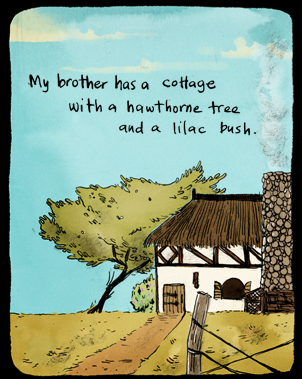
In Emily Carroll’s His Face All Red, the reader is left open to interpretation of the ending. To decide whether the main character’s brother is dead or not, and if he is the beast. Many small details of the comic can allow readers to propose the theory that the brother is in fact not dead. The first piece of evidence readers encounter, is when the main character is describing his brother’s house. Which is said to have a lilac bush outside of the house, later in the comic the main character says the mysterious hole in the woods also smells of lilac. This clue many not seem important but after the brother revisits the same hole, he finds a man who looks similar to his brother, resting within. As readers have not been made aware of the sleeping arrangements within the brother’s house at the beginning narration of the comic, thus we do not know if the brother has been  sleeping in the house or has been sleeping in the hole. The lilac smell coming from within the hole, can cause the reader to assume that the brother sleeps within the hole, and is in fact the beast.

dfs;ldkf  jrlfjls

The Reader gain the final piece of evidence when the main character is shown dragging his “dead” brother towards the hole within the woods. The face of the brother is shown with his eyes still open. The same faces is shown when the main character finds the brother within the hole, after the main character “killed” him. The illustration of the brother with his eyes open after “death”, allows a reader to assume the brother is still alive as most illustrations of people who are presumed to be dead are drawn with their eyes closed.

sfa  ljflaksj

Emily Carroll seems to have ended the comic with many questions unanswered, but the subtle use of clues within her illustration, and the way she uses narration to describe little details, allows the reader to come to a conclusion of the brothers fate.

His Face All Read: Showing, Not Telling

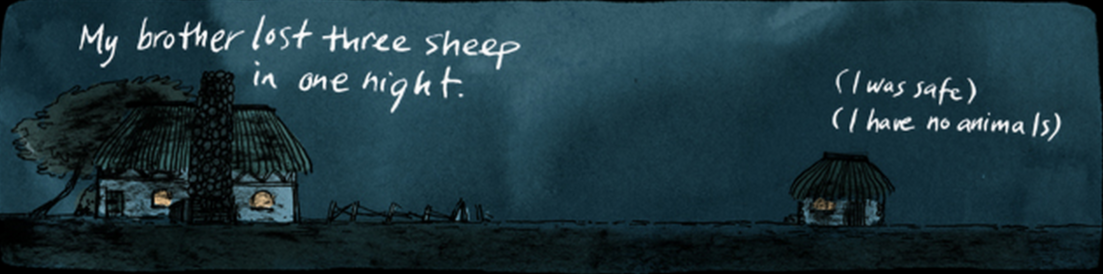
One of the oldest maxims of writing is the simple statement, “Show, don’t tell.” In her comic, His Face All Red, Emily Carroll applies this principle to her illustrations and uses the reader’s intuition to streamline and focus her narrative. Much of the subtleties regarding the character relationships are communicated through her illustrations rather than the character’s words. Take for instance the younger brother’s subordinate position in the community relative to his brother, which is depicted in the sizes of their homes.houseThe same information can also be seen in the very first frame, in which he is depicted in the far right of the frame, isolated from the community.tavernIn this way we are given detailed information about the characters from a single frame that would take a paragraph of narration to convey.

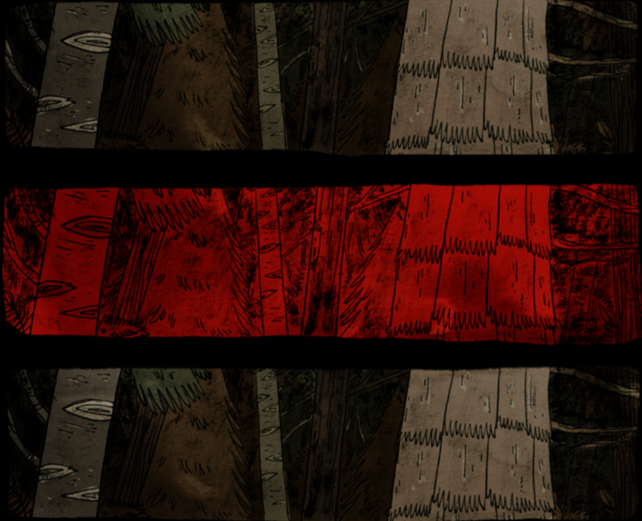
Carroll complicated the “show, don’t tell” principle by conversely using it to intentionally add ambiguity to her story. Take for instance the two instances in which she saturates the frame with red. The first time, when the older brother kills the beast, the death of the beast is taken as definite fact.beastBut the central crux of this comic’s mystery lies in the reader’s interpretation of the next instance of this device, during the murder of the brother.Capture3Here the story can branch into a multitude of different directions. The brother could truly be dead, and some shapeshifter goes on to take his place. The brother could have survived, and through some unknown circumstance ends up untouched back in the village in three days time. By not directly showing the murder of the older brother, Carroll allows for multiple explanations of the plot and creates a narrative with a unique flavor for every individual reader. First she establishes the practice of communicating definite fact through illustration, and later turns that concept on its head by intentionally obscuring the absolute truth of the narrative.

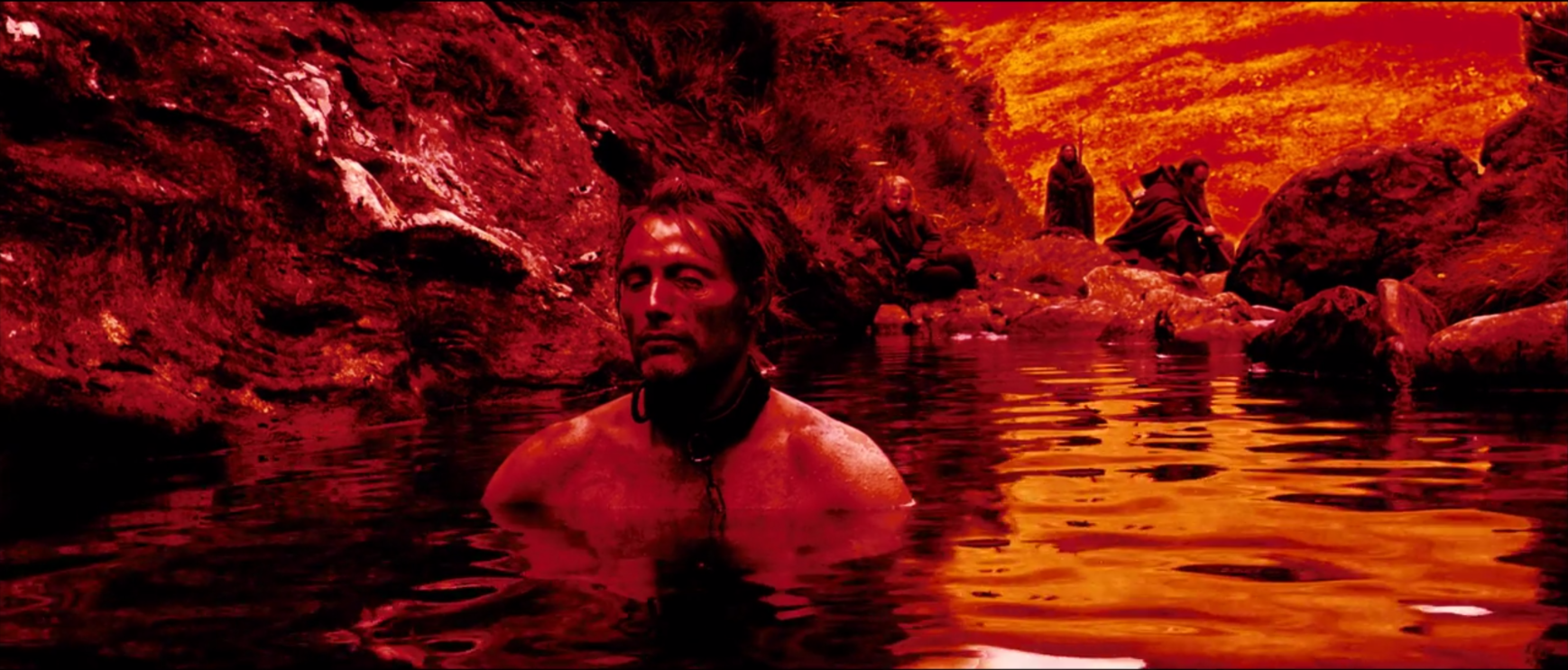
Just as an interesting aside, the film Valhalla Rising, directed by Nicolas Winding Refn (Drive, Bronson) does a very similar thing of filling the frame with red to imply violence and/or murder.Untitled

Knowledge In Frankenstein

“How dangerous is the acquirement of knowledge and how much happier that man is who believes his native town to be the world, than he who aspires to become greater than his nature will allow”

I have not yet completed the novel so I can’t comment on Frankenstein as a whole just yet but after reading the first volume one of the many, many recurring ideas that kept resonating through the pages was related to the pursuit of knowledge.

Obviously after years of being exposed to Frankenstein through film, video games, other stories, etc. We know from the beginning that Victor Frankenstein’s experiment does not end well. Whatever is going to happen in these upcoming pages is going to end up with Victor stranded, near death, on some glaciers on the way to the North Pole where he is saved by Walton. As far as how and why this experiment failed I can’t say yet but the text of volume one certainly does seem to place a lot of the initial blame on the pursuit of knowledge itself.

In one of his first letters Walton states to us his want and his need to travel. Ever since he was a child he has slaved over books and let them fuel his imagination and desire. This is a desire that can only be satisfied by stepping onto a piece of the world that no other man has yet touched. Of course alongside all this reading and imagining we learn that Walton sacrificed a lot of friendships and relationships with other humans by spending so much time with his books, and he seems to feel that, because he’s done this, he is due for a great discovery.

“Do I not deserve to accomplish some great purpose?”

Walton asks his sister. He believes that devoting his entire life to his study should now come full circle and reward him with this discovery in the north pole. Walton also talks about similarities he sees between him and his lieutenant, a man of similar kindness to him but who suffers from a deep loneliness. His story also parallels to us Victor Frankenstein’s time at college where he puts aside all relationships and family matters for years while he slaves away at his studies, grave robbing, and experimentation.

In both Walton and Victor’s stories their avid pursuit of knowledge has been associated with loneliness, depression, and in Victor’s case of course the creation of something that he is immediately terrified of. Upon bringing the creature to life, Victor flees from it and when it comes to his bedside he flees his apartment entirely and doesn’t see the creature for years.

Now the science isn’t too explicit on how this creature came to be but a part of me assumes that Shelly wants us to treat the creation of the creature like a birth. Victor himself, while working on his creature, states that this creation would bless him as it’s creator, and likens himself to be the father of this creature. So if we believe that then this creature is a baby new to this world and every single action it makes is a step towards learning something about this world he’s entered. One of his first actions is to reach out to his father and in return his father abandons him for years and we can only imagine that he suffered through years of loneliness and desperation until he and Victor meet again.

So what is Shelly trying to say? As a romantic novel a criticism of the pursuit of knowledge would be vastly against type, but perhaps she is just trying to say that there is a limit to the lengths humans should go. Maybe there’s a line in Nature that we are not meant to cross. Maybe Shelly is trying to advocate for a life lived in Nature as opposed to in the study. Every time Victor feels happy in this volume is when he is surrounded by family or witnessing the beauty of nature, and whenever he’s sick or depressed or haunted Shelly makes a point to let us know that he is missing all the nature happening around him.

I can’t answer these questions yet as I’m only 1/3 of the way through the novel but I’m interested in seeing how this idea of the pursuit of knowledge continues to occur in the novel.

Textual Analysis: The Night of Creation

In the first volume of Mary Shelley’s Frankenstein, chapter V begins with a short paragraph that precedes the pivotal creation scene. Through the selection of fervent diction, incorporation of grim detail, and utilization of haunting imagery, Shelley generates a setting that both exemplifies characteristics of a Gothic novel and foreshadows Victor’s unfavorable feelings towards his creation.

The illustration of “a dreary night of November” with “rain patter[ing]” against the windows immediately generates a gloomy atmosphere. The description of Victor working past “one in the morning” on a cold, wet, and dark night when most people are asleep, stores are closed, and towns are quiet depicts a morbid silence interrupted only by the “disma[l]” cadence of rain drops and sounds of Victor’s work with his “instruments of life.” Shelley’s incorporation of a metaphor for Victor’s scientific tools integrates a supernatural element and poses a question regarding Victor as a God-like figure with divine power. Additionally, the decreasing illumination of a “nearly burnt out” candle further develops a disturbing scene. The darkness from outside slowly bleeds into Victor’s laboratory, casting shadows and indicating that soon blackness will become all consuming.

After much hope, apprehension, research, and “toils,” Shelley reveals that Victor finally succeeds in his endeavor to create life. However, Shelley purposely connects what should be a bright and happy moment with the downcast mood of a stormy night, the unnerving image of darkness, and Victor’s dehumanizing description of his creation. This juxtaposition exemplifies a tactic to foreshadow not only Victor’s unhappiness, but also future horror and dread that will follow his “accomplishment.” Although Victor aspired to create a human being, in this passage he only refers to his creation as a “thing” and a “creature.” Through the description of a “yellow eye” like that of a lizard, an unnatural and inhuman characteristic, Shelley exemplifies an act of dehumanization and foreshadows Victor’s detachment and disgust towards his creation.

Margot’s Room Analysis: The Power of Obsession

Used/Uploaded by: VenusGrace17

Obsession is a type of behavior that usually connoted negatively and is defined by the Merriam-Webster dictionary as “a state in which someone thinks about someone or something constantly or frequently especially in a way that is not normal.” In Emily Carroll’s digital graphic novel, “Margot’s Room,” this ongoing theme is emphasized greatly through both the narrator’s and her husband, Gilles’, lives and behaviors throughout the story. As the reader follows the story, it is clearly evident that the wife has issues distinguishing between reality and fantasy due to her downward, obsessive spiral. Gilles suffers as well but has a more generic aftermath (distancing oneself, marriage issues, etc.) of his daughter’s death while the narrator suffers from something darker.

In Part I, Flowers, the husband is seemingly happy, or aloof, despite that his future wife’s father, his ex-boss, had just passed away from an unspecified illness. There is also the possibility (that many readers interpret) that either he killed his boss in order to have his wife all to himself, or that it could have been the other way around, she killing her father to be close to him: both being signs of obsessive behavior.  However, in this part, the main focus is on how the narrator keeps speaking of her feelings in the past while juxtaposing them with the present’s, and how she is obsessed with the death among her loved ones. The last frame records her saying “he promised he’d live forever,” emphasizing the inability to move on, and her focus on death. So even in the first frames we meet the pair, there is already something uncanny about their relationship and the odd manner they deal with death.

In Part II, she cannot move on from her daughter’s, Margot, death and wonders whether she could have done anything to prevent it. At this point, it’s fairly evident that her obsession with her daughter’s death is what drove her husband away, despite his efforts to comfort her.

Part III presents the same obsessive behaviors that the narrator had previously exhibited and she herself notes that she spends most of her time alone waiting for her husband’s return. In addition, Gilles also begins to spend a longer time away from home since he was very affected by the death of his daughter and his wife’s conduct. At this point, it’s also evident that he is obsessed with Margot’s death as well and also becomes an unreliable narrator, especially when his wife discovers the villagers never saw him at all, thus, invalidating his alibi.

The narrator’s obsession with her daughter is elaborated upon in Part IV when she endlessly ponders on the life Margot did not get to fulfill, asking herself whether it “was it kindness in the end?” Obsession often clouds a person’s mind with intense anxiety and can be the reason why she drove her husband away from her and caused him to “change.”

The power of obsession is what allowed the narrator to murder her husband, she did not see anything realistically anymore and neither did he since she was plagued with illnesses and deaths. Just as the monsters that Gilles saw in the woods could have been a representation of the obsession they have possessed from dwelling on the death of their daughter. Whether or not it was a supernatural occurrence or their own insanity, their obsession with Margot’s death brought them to these circumstances, and ultimately drove the narrator to murder her beloved husband.