In Sheep’s Clothes

There is a beast in my town.

I live in a quiet place, With peaceful people and friendly neighbors.

There’s a lake nearby with fish and ducks,

A forest filled with deer and rabbits.

The town is filled with smiling faces,

Happy people waving and cheering.

But I am not fooled.

I know the truth.

There is a beast in my town.

I see it in the corners of my eye,

In the shadows between buildings.

Always watching. Always hunting.

It stalks me as I walk around town,

Vanishing as soon as I turn to face it.

I’ve warned my neighbors, warned them of the danger.

And yet they continue to smile, continue to laugh.

But now that laughter is pointed at me…

There is a beast in my town.

But he won’t be able to hide much longer.

For now I have begun my hunt.

No more will I be the prey, No more will I feel fear.

I know it is out there, watching me from the shadows.

I know what I must do.

There is a beast in my town.

And every day there is one less smiling face.

The people no longer laugh, no longer wave and cheer.

They are afraid, afraid of the beast that they now believe in.

But they can’t fool me.

I know that the beast is one among them.

And every night I will continue my hunt.

Until I know for sure that I have killed the beast.

Until I know that it isn’t hiding behind one of those smiling faces.

There is a beast in my town.

And I will find it.

“The Sapling” Explanation

I got the inspiration for “The Sapling” from volume one of Mary Shelley’s “Frankenstein”. In my poem, the sapling represents Victor Frankenstein. I wanted to illustrate the image of Victor as an innocent young person before he becomes interested in metaphysical science. The old trees in the poem represent the scientists that Victor becomes obsessed with into his youth such as Cornelius Agrippa, Paracelsus, and Albertus Magnus. Though no one else thinks these scientists are worthy of time or study, just as no one thinks the old trees’ fruit is sweet enough to eat, Victor and the sapling still hold onto them. The growth of the fruit on the sapling is meant to represent the work that Victor puts into the reanimation of the creature. Though Victor thinks that his creation will be this wonderful thing that will change the world for the better, it turns out to be a frightening (and possibly murderous) monster, just as the apples of the sapling look ripe but are terribly rotten (and possibly poisonous).

The Sapling

In the center of the garden

grew a sapling, never after forgotten.

Summers came, and Winters passed,

through many years this tree did last.

Its roots grew deeper and entangled

roots of trees no longer able

to bear fruit of ample sweetness

to attract one’s tongue to witness.

The old trees spread this malady

through their roots to the young sapling.

As those old trees withered down,

the young tree’s branches were abound

with the blossoms that preceded

the growth of apples, unimpeded.

Though the fruits appeared so red,

the inside filled each taster with dread.

There was no sweetness, only a bitter,

toxic, and pernicious flavor.

Worse than the flavor, was the sight

of fruit’s flesh that was black as night.

Though promising this sapling was,

its fruit has broken nature’s laws.

No more seasons came to pass

before the sapling was replaced by grass.

His Face All Blood Orange: On the Unreliable Narrator of “His Face All Red”

“I can no longer sleep.

I have dreams.

His legs limp.

His face all red.

And twice I have woken 

and seen my brother

digging.

Is this guilt?

Or is this my brother, whole, not a double?

And if so…

Why won’t he turn to look at me?”

“His Face All Red”, a comic by Emily Carroll, follows the story of a man who murders his brother in the woods near their town, only to have him return alive and apparently unscathed three days later. The story is ambiguous about whether the “man” who returns truly is his brother, or if he is somehow connected to the mysterious beast who, up until recently, had been attacking the town’s livestock; but what is equally ambiguous is whether the protagonist himself is altogether trustworthy. The way the main character is portrayed throughout the story implies that he may be an unreliable narrator, and whether or not the reader decides to trust him shapes their interpretation of the events that follow.

From the beginning of the comic, the protagonist, who remains unnamed along with the rest of the characters, is portrayed as an outsider. In social settings he is always shown sitting off to the side by himself while his brother mingles, and he is never depicted with friends or companions of his own. When he first volunteers to hunt down the beast that has been threatening the village, the townspeople all laugh until his brother offers to go with him. It is never specified why the townspeople treat him this way, but it is clear that he does not hold their respect. The protagonist’s social isolation and probable low social status within his small village communicates that there may be something “off” about him that causes others to distance themselves.

Another hint is the paranoia the protagonist displays both before and after murdering his brother. When the pair first enters the forest to kill the beast, our main character describes passing a tree “with leaves that looked like ladies’ hands” and a stream “that sounded like dogs growling”, which his brother dismisses as simply a “common oak” and a “babbling brook”, respectively. The fact that he perceives these things as somehow vaguely threatening despite having lived next to this forest his whole life is strange to say the least – and quite telling of the protagonist’s mental state, not to mention the fact that he goes on to murder his brother without a second thought (and without changing his facial expression).

After he murders and disposes of his brother he claims that he “feared another attack”, which comes across as odd since his brother had already killed what he thought was the beast, and he himself had just killed his brother. Who does he think is going to attack him? At that point his brother had not returned from the woods, so it is unreasonable to assume that he’s afraid of his brother retaliating. These demonstrations of paranoia paints the protagonist as someone whose perceptions of things may not be entirely accurate.

Finally the twist ending – the main character finds that his brother’s body is still in the hole where he dumped it despite his brother having returned to the village safe and sound. This forces the reader to decide: is the protagonist crazy, or are there supernatural forces at work? It’s entirely possible that the “brother” the protagonist sees return to town is a manifestation of his own guilt over killing his brother in cold blood. Seeing that he never really interacted with the people around him all that often to begin with, it doesn’t seem implausible that he is imagining these events, where the townspeople rejoice at the return of his brother from the presumed grave, as a coping mechanism, and that his fantasy remains unchecked because of his very limited social interactions. Or, alternatively, he may never have killed his brother at all, and he only imagined that he did because of the intense jealousy he feels for him: the fact that his brother’s “corpse” appears to move at the end of the comic may be alluding to it being another one of his nightmarish perceptions of what is in actuality something commonplace. Either way, the comic makes a solid case for an unreliable narrator, which makes for a thought-provoking reading experience.

( ) – An Explanation

This formatting piece was composed with inspiration from Emily Carroll’s distinct style of parentheticals, layout, and patterns that so instill the atmosphere of her work. Every quirk, change, or abnormality in the writing is a reflection of Carroll’s intentions. Whether an aside representing the narrator’s internal struggle or an alternation between vertical and horizontal scrolling on the webpage, every detail is planned out by the artist.

My goal in creating this piece was to draw attention to Carroll’s formatting style as an art form and how it contributes to the constant paranoia of her character’s minds. I used words like “doubt” and “repetition” to portray the way in which she gives these brief characters so much depth as well as providing the reader with a more complicated narration style. All of these factors contribute greatly to the ambiguity of her work and how not knowing can be far more suspenseful than knowing.

Em Carroll and the Impact of Interactive Storytelling

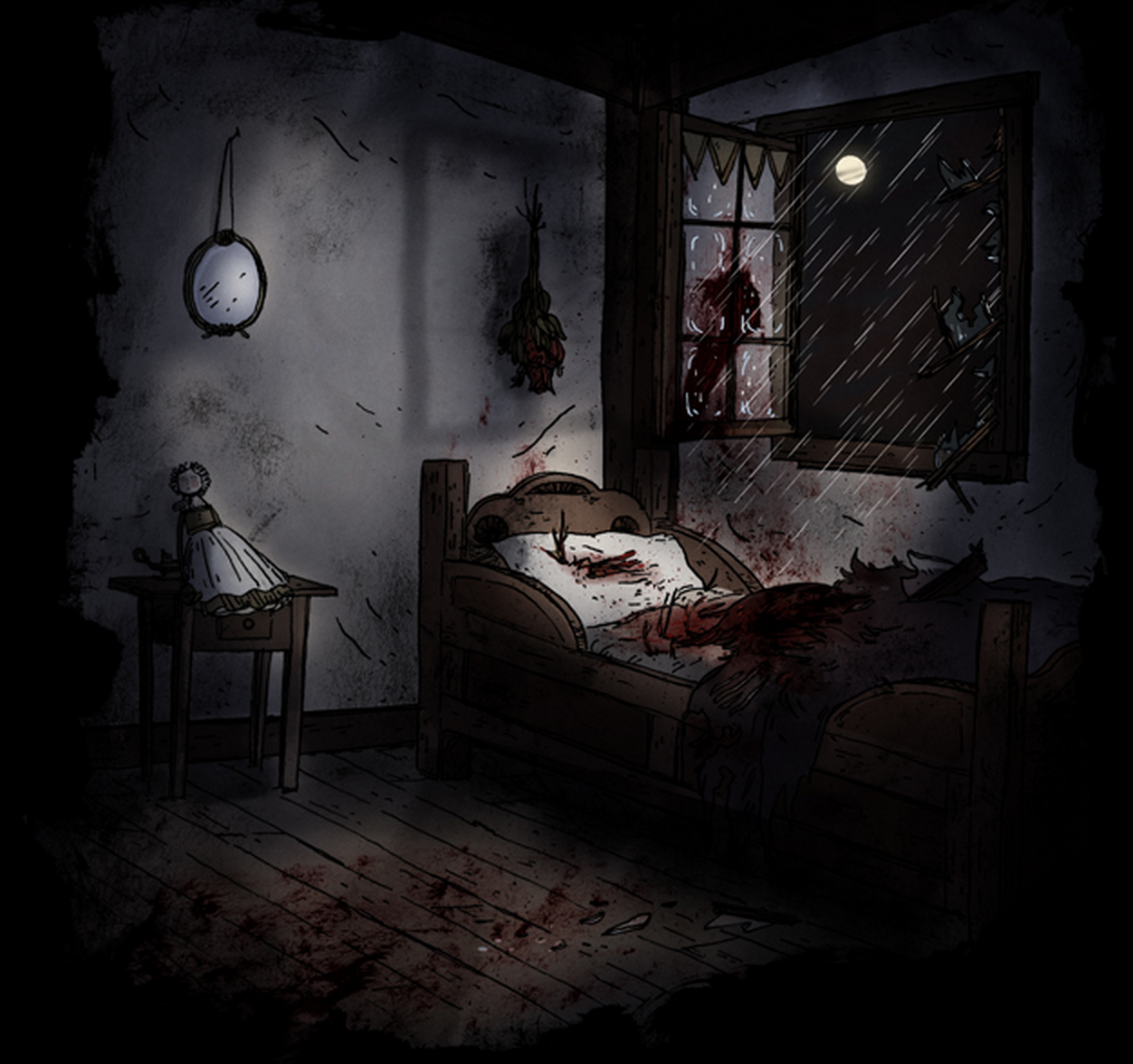
Em Carroll’s “MARGOT’S ROOM” is, first and foremost, a choose-your-own-adventure story (with the story leaning deeper into horror as the comic develops). From the first page, the reader is prompted with a poem and a choice: Screen Shot 2015-09-07 at 11.15.35 PM

Aside from the immediate unease offered by the grisly scene presented by the first page of the comic, the necessity of the reader’s choice to engage and the “path” travelled by the scrolling patterns of the major contributors to the overall dread and horrific impact. The conceit of horror films and animated horror series is that you are being told a story; you passively accept the images, sounds, and dialogue of the tale, and your engagement is limited to your mere presence. Em Carroll, through her use of interactive choice and unpredictable scrolling, removes the passivity of the audience and forces them to choose to immerse themselves in the story and walk (with keystrokes) through the panels of the comic.

The entire story requires being actively unpacked by the reader to be told; once again, this aspect of MARGOT’S ROOM is one of the defining horror elements. The chapters that best display the interfacing of this narrative style and the scrolling involved in the comic are chapters V and II.

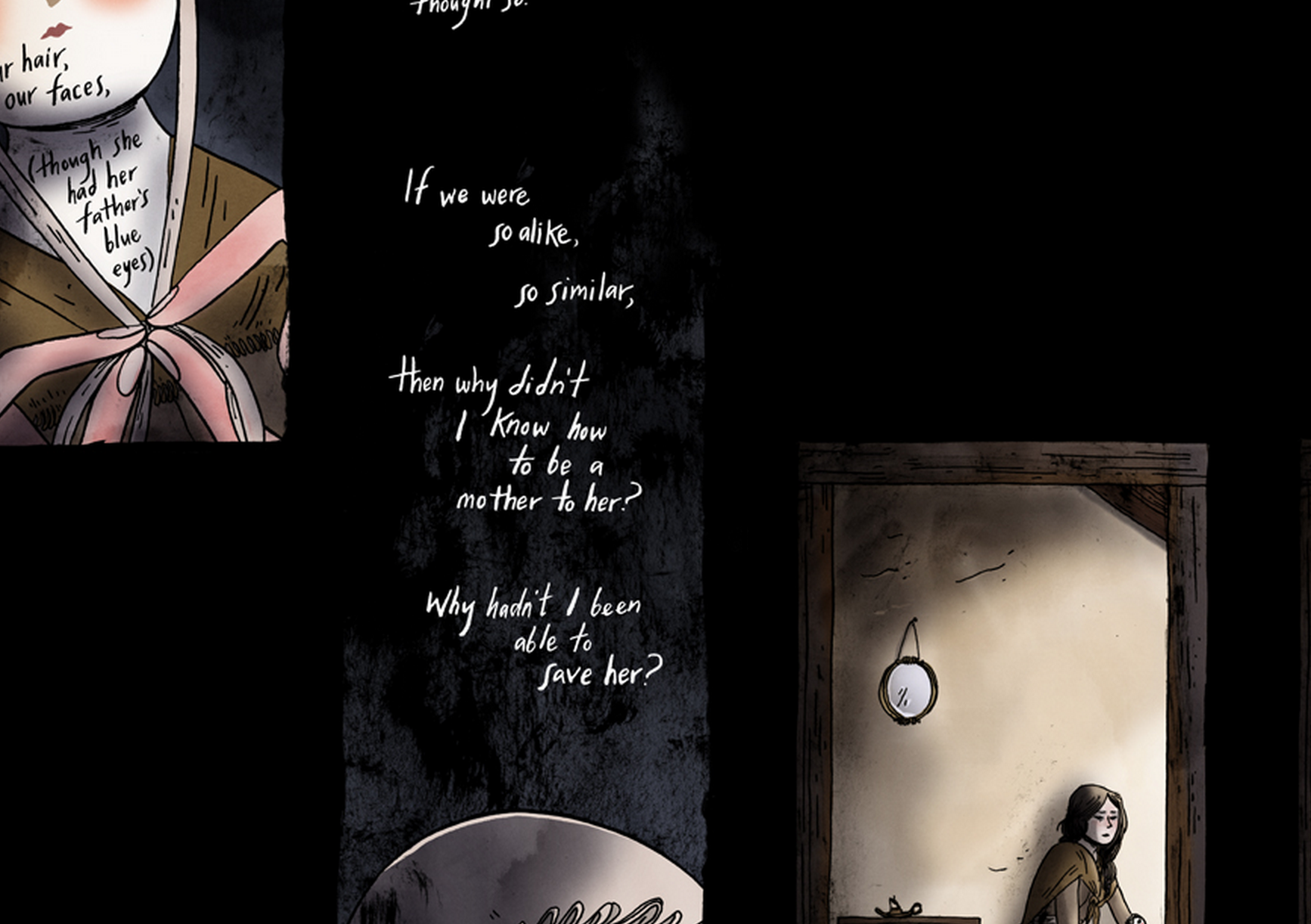
Screen Shot 2015-09-07 at 11.29.32 PM

While very difficult to capture, we see that at this point in Chapter II there is a near-physical “drop” in the story. The reader has to adjust their scrolling, changing the orientation of the comic and providing a sense of dread at the literal descent in the narrative path – again, a descent that the reader chooses to follow, which heightens the suspense of the unfolding dialogue.

This combination of effects is felt the most in Chapter V, where the reader reaches the “climax” of the story. There are three more of the drops mentioned earlier, and following the trail of the panels is at its most difficult and unsettling in this chapter. The discordant movement of the story from panel to panel drags the reader further and further down the screen, at times losing them in the blackness of the background page until they manage to stumble upon another unsettling panel of the murder at the end of the story.  This physical element breaches one of the only sanctities found when regarding horror: the fact that you are completely disconnected, physically, from the story. Carroll’s uses of the discussed techniques creates deep intimacy between the story and the reader, allowing the comic to transcend the flat, distant nature of horror media.

Jealousy and Delirium in His Face All Red–An Analysis

Emily Carroll’s web-comic, His Face All Red, focuses on two main characters—the Narrator and his Brother. Neither is named in the story, therefore I have capitalized their titles for referencing purposes.

The Narrator immediately builds sympathy for the Brother by describing him as handsome and trustworthy, while painting himself as envious and unpopular. Due to an unreliable narrator, the only thing I can tell for certain what is true are his emotions, as his story may have untruthful elements pertaining to events and appearances. For example, it is not clear if when the characters pass by a tree and stream whether the descriptions are simple similaic descriptors, or if the trees and streams in this fictional world actually look and sound like that.

After the Narrator kills the Brother, he is celebrated for slaying the beast that was terrorizing the village and is given his Brother’s animals. He seems content here, as he notes he dreamt of nothing. One part of the story is that the Narrator is the only one who notices the Brother’s coat is not missing the piece he ripped from it. If the Narrator really did take a piece and show it to the townspeople for proof of his Brother’s death, why then was he the only one who noticed? I suppose everyone could have been too overcome with joy to notice for themselves. This is peculiar nonetheless.

The Narrator seeing the Brother at night digging could be a hallucination or an actual event, but at this point in the story he is just as confused as the reader, if not more so due to him not being entirely normal/sane at the beginning.

In the hole the Brother was deposited into, the Narrator comes across a body. Personally, it was hard for me to tell if it was the Brother’s or not as all that was shown was some hair and an eye (and the outline of his jacket I suppose). It is possible that it could be the Brother: the Narrator had just finished asking why the Brother who had come back does not look at him, implying his Brother usually does. The eye shown looking at the Narrator in the final scene could be a reference to that. It could possibly be any sort of dead body. What the Narrator finds may not even be real; he could be imagining whoever/whatever he found down in that hole, as his mind is clearly not in the best shape.

( )

(CON – FUS    ION)                                                                                  (FE  AR)                                       (REPETITION)

  (SEL     F-DOUBT)                                    (ANGER)                 (      VIOLENCE)
(REPETITION)                    ( DARKNESS)

     (    PARANOIA    )                      (GUILT)          (MISTRUST)

           (PAIN)                                 (REPETITION)        (DOUBT)

   (DOUBT)

(DOUBT)

(DOUBT)

   (MONSTER)                  (DEATH)                                        (       FRAGMENTA    TION)

(ALONE)

Fate in Frankenstein

Intertwined within the narrative of the first volume of Frankenstein, the title character constantly experiences moral dilemma as a result of his actions. The whole story being told in retrospect makes the reader aware that, in the present, Frankenstein fully understands the destruction that he and his creation caused and in the time leading up to and following these events, he considered the factors that saw them to completion. However, what Shelley doesn’t make quite clear through this story-telling technique is that Frankenstein considers himself fully responsible.

In the 1831 revision of Frankenstein, Shelley strays from the idea that the doctor himself, and any underlying corruption of morality on his part were to blame for the evil he ended up creating. In this way, Frankenstein’s creation is instead the result of a confluence of predispositions that could have influenced anyone with Frankenstein’s interest in science and life history to have completed the same action and have arrived at the same result.

It seems that with each misfortune along this timeline that Frankenstein describes, he’s compelled to send a shoutout to fate for being the reason they were ultimately unavoidable. When his mother dies, he calls the death an “omen of future misery,” owing to his ensuing preoccupation with death. Even to seemingly ordinary elements of his personality he assigns a great significance over what happened in his future (i.e. his passion for science), but blames fate and destiny for being the reasons that he couldn’t stop himself from following a path that would lead him to creating the monster.

In some instances, Shelley’s preoccupation with the idea of an unchanging fate serves on a somewhat shallow level as fuel for the movement of the plot, in that some events are written-in solely so that Frankenstein will eventually find himself at a place where his decision to create the monster seems like the only available one. In this way, fate is a force that seals itself, regardless of Frankenstein’s say in the matter. On another level, Frankenstein’s continual accusation of fate redirects any discussion of his morality for the characters in the book and supposedly also for Shelley. In reality however, such an argument might not hold the same ground.

Frankenstein the Monster

When Robert Walton rescues Victor Frankenstein from the freezing Arctic waters, Frankenstein immediately faints and needs to be “re-animated” with a small amount of brandy (Shelley 26-7). Once he recovers, Walton takes care of him and treats him kindly even though “his eyes have generally an expression of wildness, even madness” and “he gnashes his teeth” (27). Walton is able to see “benevolence and sweetness” (27) in him and begins to “love him as a brother” (28), even though he barely knows him at all.

In contrast, when Frankenstein gives life to his creation, he is immediately horrified and abandons it in his laboratory (58). He is disgusted by the creation’s physical appearance, even though he picked each piece of it himself (58). He doesn’t even try to talk to or understand the thing to whom he has given life. In fact, the creature opens his mouth and may have been trying to talk to him, but he is not listening (59).

It could be that once a person has, like Frankenstein, attained the unthinkable and unnatural — the sublime — they are unable to reconcile with their own humanity. By laboring obsessively and neglecting correspondence with his family (55-7) Frankenstein has become alienated from humanity and become purely a vessel for science. Frankenstein refers to this state as a madness (29), and attempts to prevent Walton from pursuing a similar path of passionate scientific endeavor (29).

Frankenstein perceives himself as having created something monstrous which originally seemed only beautiful until he reflected on his work (58). This is all too apt a metaphor for the life he has created for himself over the 2 years he obsessed over his re-animation project. When Frankenstein says that “breathless horror and disgust filled [his] heart,” this is as a result of his deprivation of rest and health (58). He has become a monster in his narrow-sightedness and is desperately trying to stop the creation of another monster (of Robert Walton) by relaying his tragic story.