The Ancient Mariner: Victor 2.0

In chapter V of volume one in Mary Shelley’s Frankenstein, Shelley alludes to the final section of Samuel Taylor Coleridge’s poem “The Rime of the Ancient Mariner”. The allusion foreshadows what is to come for Victor as a result of his endeavors, with the story of the mariner acting as a foil to not only Victor’s experiences but also Shelley’s novel as a whole. Coleridge’s poem tells the story of an old sailor and how his endeavors on the sea accidentally result in the death of his crew at his hands. A young man on his way to a wedding finds the sailor’s story captivating, and “cannot choose but hear” (Coleridge 18). The young man foils the character of Walton, as Walton finds Victor’s story completing enthralling, and the old sailor serves as a foil for Victor and the regrets he has over his aspirations.

The excerpt that is included in the text is quite ominous, and if one did not know the context behind the poem it would seem simply about the fear that Victor feels because of his Creature. Shelley inserts the allusion at the point in the novel when Victor is appalled with himself after succeeding with his Creature. The “frightful fiend” that “doth close behind him tread” alludes to the Creature, and Victor’s fear that he is following him. While this literal meaning is important as well, it is only when you delve into the poem itself that the deeper meaning behind the allusion arises. For those of us who have read Frankenstein before, we know how Victor’s treatment of his Creation drives the Creation to do certain things. This mirrors the way that the old sailor’s actions drives his crew into death, without him intentionally meaning for them to die. Victor’s proceedings in creating life will cause pain and suffering to those around him without that being his intention. Victor also resembles the sailor in that both of them “wear” their wrongdoing around their necks to haunt them forever. In the sailor’s case he is forced to wear the Albatross that he killed as a constant reminder of his role in the curse on him and his crew. For Victor, the situation is not quite so literal. His version of wearing the albatross is having to deal with the Creature’s murder of his loved ones and his constant reappearance. The naivety and ambition in both the old sailor and Victor are ultimately their downfall, and Shelley’s inclusion of this excerpt serves as a warning to the reader of what is to come and what we can learn from them.

Sample Analysis: Illness in Margot’s Room

Emily Carroll’s comic, Margot’s Room, can be read both on a literal level (a man transforming into a werebeast) and on the metaphorical (the onset of depression and domestic abuse following the death of a child). Patterns and clues tend to emphasize narrative ambiguity rather than clearing it up. One of the main sources of confusion for me is the role of sickness in character deaths and transformations.

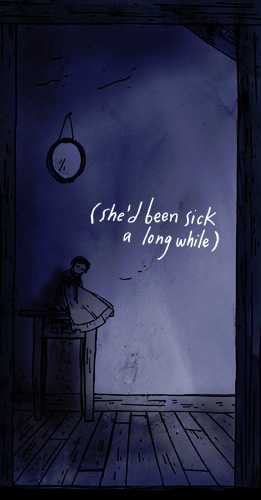
When we are introduced to the narrator, she notes that “I was feeling sick” during her father’s funeral.CaptureFollowing on the heels of her understandable response to this dark situation, she implies to her future husband that she is not shocked by her father’s death because he’d been “sick for a long while” – and perhaps doesn’t even view it as “tragic.”

CaptureIllness, and in fact, that exact phrase “sick for a long while” heralds another dramatic turn in the plot when Margot, their daughter, dies off screen.

Capture

Up until this point, we see that sickness (particularly that of the “long while” variety) serves as a precursor to the rise and fall of relationships. The narrator’s relationship with her father appears to be stilted and perhaps estranged (in early panels, she mentions that the entire village shows up for the funeral, but no one approaches her or even attempts to find her). Her stoic reaction quickly transitions into bright scenes of her wedding (again, with no villagers in the background) with Gilles. The father’s illness, her own sickness are never mentioned again now that she has what she desires – attention, affection, and Gilles. Later, the narrator’s guilt that she is a failed and unsuitable mother is reflected in her statements that she “never thought” her daughter was like her (that in fact, Margot was so physically similar to her husband). This discomfort is linked to Margot’s “long” death, and the eventual destruction of the narrator’s marital peace. Finally, Gilles himself is described as changed and transformed, paralleling the deterioration of household peace.

Illness, if understood literally, almost functions as a curse following the narrator and tainting those in her life. If applied on a metaphorical level, we can see that illness describes the narrator’s isolation from the community, and seems to insert itself into relationships in which the narrator is overwhelmed by self-doubt and/or resentment. Rather than visually confronting these moments through memory, the narrator only shows us her rationalization, her repressed guilt (deserved or not) through tenuous repetitions of “sick a long while.”