Storms in Frankenstein

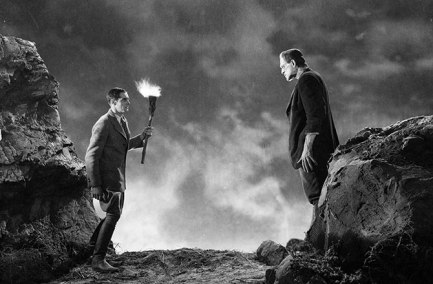
The language of nature is particularly prevalent throughout Frankenstein by Mary Shelley. Though these descriptions of nature are often just the passing thoughts of Victor, sometimes certain natural themes are used for a specific purpose. Throughout Frankenstein, storms are used to foreshadow the terrible events that are soon to come in the life of Victor Frankenstein.

The first two storms described in the book foreshadow terrible events in that they transform Victor’s life in ways that eventually come back to haunt him. The initial storm is when Victor witnesses the oak tree being electrocuted by a strike of lightning. This storm leads to Victor pouring himself into the study of science and looking into galvanism. These studies lead to Victor’s scientific pursuits at Ingolstadt, and therefore to his creation of the creature which is eventually horrific for Victor. The next storm immediately precedes the scene in which the creature is given life. Though Victor is looking forward to the successful animation of his creation, the life he gives to the creature turns what he thought was a masterpiece into his worst nightmare.

After Victor finds out that his brother William was murdered, he hurriedly travels back to Switzerland. On his way home, when he is nearing Geneva, a storm passes through the mountains and thunders around Victor as he mourns for his late brother. As the storm is reaching its peak, it sends down a strike of lightning that illuminates the creature for Victor to see. This leads Victor to make the connection of the creature’s coincidental presence to the recent murder of his brother, and drive him to hate the creature (and himself for giving the creature life) even more ardently. When Victor wanders to Chamounix and Montavert in an attempt to get over the contempt he feels toward himself after the deaths of William and Justine, he encounters yet another storm as he is ascending the  mountain. When he reaches the summit, he encounters the creature who then tells Victor his life story and asks him to make him a female companion which leads Victor into a state of depression and disgust for himself until he destroys this new creation.

The next couple storms foreshadow the deaths of Victor’s closest companions. The first of these hits when Victor leaves Scotland to attempt to reunite with Henry Clerval. This storm takes him all the way to Ireland where yet another misfortune befalls him. He survives the terrible storm only to find Henry murdered by his creation.The next storm brought tragedy in the death of Victor’s bride and lifelong friend, Elizabeth. The storm starts right before Victor tells Elizabeth to go to sleep in the very room she is murdered in minutes later.

The last storm in the book occurs when Victor is chasing the creature through the arctic. Just as Victor is closing in on him, a storm hits and breaks up the ice and Victor loses his last chance for revenge. This storm leads to his debilitation and sickness which eventually leads to his death upon Walton’s ship. Though these storms could have all been coincidental, the continual placement of their descriptions show an undeniable connection to the terrible events in the life of Victor Frankenstein.
Social Commentary through Ignorance

The rapid socialization of Frankenstein’s monster allows Shelley to critique her modern society through the lens of a tabula rasa. The description of the monster’s first forays into the world, including such scenes as the gradual differentiation of his senses (105-106) and his accidental burning of himself (106) firmly establish the monster as having a complete lack of any experience or inherent nature. With no meaningful cultural context to color his perceptions of the world, all of his emotions and reactions are brutally honest and fervent. Having experienced fear and brutalism in his encounter with the villagers (109) as well as tenderness and love in the interactions between Agatha and her father (110), the creature has been exposed to both sides of human nature.

This dichotomy in human behavior further troubles and confuses the creature upon the arrival of Safie, and the more formal education he then receives in history. The “stupendous genius and mental activity of the Grecians” is told in parallel with the “hapless fate of [America’s] original inhabitants.” These seemingly mutually exclusive realities inspire a sort of cognitive dissonance within the creature: “[Man] appeared at one time a mere scion of the evil principle, and at another as all that can be conceived as noble and godlike (122).”

The creature’s profound sensitivity gives a weight and sense of urgent abhorrence to the darker aspects of society that the average person views as simple realities of life. Concepts such as murder and violence are so repulsive to the creature that “for a long time [he] could not conceive how one man could go forth to murder his fellow, or even why there were laws and governments…(122)” Because of the fact that he has no experience to dull his senses, he is able to approach the harsh realities of society such as murder, violence, and social inequality with a unique sense of suffering.

By giving the “wretched” creature these haunting insights, Shelley challenges the reader to truly empathize, and to recognize the true horror and wretchedness of those aspects of society we accept as immutable. Shelley gives the most profoundly human insights into the failures of mankind to the one character inherently lacking in humanity.

The Ridiculousness of Romanticism

Victor Frankenstein of Mary Shelley’s Frankenstein focuses highly on nature, and how his view of nature is affected by his mood or vice versa. His constant jump from being inspired by nature to not being capable of appreciating it makes it difficult for the reader to take Frankenstein seriously, and thus leads the reader to question his character. The unreliability and distrust in Frankenstein that is created can be seen as Shelley’s personal commentary on the exaggerated literature of Romantic writers of the time period and their resulting egocentrism.

Frankenstein often dramatizes his current mental state through lofty descriptions of the natural world around him; it appears to the reader that Frankenstein is either full of joy or despondent beyond recovery. After the death of his younger brother, he escapes into the mountains where he vacationed as a child and claims his surroundings fill him with a “sublime ecstasy, that [gives] wings to the soul, and [allows] it to soar from the obscure world to light and joy”. The use of the words “soar”, “light” and “joy” when discussing the soul alludes to heaven and angels, giving Frankenstein’s trip up the mountain a transcendent and biblical quality. This is similar to Romantic writers such as Wordsworth and Shelley, in that they compare nature and their overwhelmingly inspirational experiences in nature to God and the idea of the “sublime”. However, only a paragraph later Frankenstein’s entire outlook on nature shifts with his fresh bad mood. The scenery that Frankenstein had before compared to heaven transforms into a “sombre” place with “thick wreaths” of mist and a “dark sky”, or in other words a different and more ominous “sublime”. With this word being tossed around so frequently by Frankenstein to mean both amazing and awful, the reader is given the impression that he is not to be trusted. His changeable attitude largely reflects the writings of Romantic writers such as Shelley’s husband, and helps to highlight the egocentrism involved with Romanticism. The highly dramatized use of such strong polar opposite emotions exudes a sense of egotism within the character and, as Shelley’s novel implies, the author as well. Victor is certainly a self centered character, made obvious through his constant concern that the monster is going to kill him despite the large amount of evidence that it is the people he is close to that are in trouble. Ultimately Victor Frankenstein embodies an almost laughable amount of egotism and changeability that the reader can connect to Romantic writers.

In conclusion, Frankenstein’s inability to figure out what he truly feels, as represented through his view of nature, highlights the ridiculousness of self centeredness and the sensationalization nature and everything that is both beautiful and terrifying that is the center of Romantic writing.

Textual Analysis: A Shift in Power

Chapter II of Volume II in Mary Shelley’s Frankenstein features a dramatic encounter between Victor Frankenstein and his creation. While the creature’s desperate plea for an opportunity to articulate his story suggests his lack of power and subordinate status, the creature’s utilization of persuasive and complex language through the integration of a rhetorical question and Biblical allusions not only reveals an underlying accusatory and commanding tone, but also exemplifies a shift in power roles.

As the creature implores and “[e]ntreat[s]” Victor “to hear” him so that he might be understood rather than unfairly misjudged and undeservingly subjected to rejection, it appears that the creature assumes a position of inferiority through this act of begging. However, the creature’s command for Victor to “be calm,” quiet, and open-minded “before…giv[ing] vent to [his] hatred” not only discloses how the creature immediately takes control of the conversation by giving orders, implying that any and all requests should be understood as demands, but also reveals the creature’s accusing tone. In presuming that Victor will respond with antipathy, the creature insinuates that a hostile nature is typical of Victor. As a result, Victor is cast in an unfavorable and negative light. While the creature is willing to return to his innate “mild” and “virtuous” self despite all that he has endured, the expectation that his creator will react solely with resentment distinguishes Victor as ranking below himself by quality of character.

In addition to the creature’s physical dominance of “superior” height, strength, power, and skill that he instructs Victor to “remember” and recognize, belittling Victor as if he is a child that needs to be told the obvious, the creature also gains the upper hand intellectually. Unlike Victor who converses with short and curt statements, the creature, displaying an eloquence and mastery of the human language, confronts Victor with an elaborate speech and a rhetorical question. Analogous to a leading question in court, a query proposed to suggest a particular answer, a verbal response is not required to disclose and confirm Victor’s desire to both “increase” the “suffer[ing]” of and inflict further “misery” upon his creation. Through this rhetoric, the creature not only maintains command of the encounter, but also shapes his speech to both accuse Victor of cruelty as well as highlight him as an evildoer.

Furthermore, by comparing himself to both the “fallen angel” and Adam, the creature continues to rise to a position of superiority. The creature elevates himself to a divine status greater than that of man like Victor as well as discloses that he was spurned without reason. Unlike the angel that was cast out of heaven for a “misdeed,” the creature, despite his “benevolent” nature, was “irrevocably excluded” from society without engaging in any wrongdoing. The creature, placing blame, reveals that he was “trample[d] upon” and despised not only by the human race, but also by the one individual that “owest” him most, his creator. While God made Adam in the likeness of Himself, instilling life and love into a being considered to be perfect, Victor proves unable to love a thing so frightening and ugly. Impulsively abandoning his creation and child, his Adam, out of disgust, Victor denies the creature of “clemency[,] affection[,]” and endearment; exemplifying that he is not only lesser than God, but also lesser than a mortal parent. As a result of continual neglect and failure to fulfill his duty as the creator, Victor has lost control of all outcomes regarding his creation and child. The creature clearly indicates that he is no longer the inferior party.

Victor Frankenstein and the Art of Subterfuge

There was a passage at the tail end of the third chapter of volume three that shed a particular light on the storytelling methods of Victor Frankenstein. On page 175, right after he’s destroyed the female half-creature, Victor gives his audience (Walton) an assessment of his situation: “I had resolved in my own mind, that to create another like the fiend I had first made would be an act of the basest and most atrocious selfishness.” This statement serves to complicate interpretations of Frankenstein’s moral leanings throughout Shelley’s novel. Throughout the course of his wanderings, Victor has made it evident that his family is not necessarily a top priority. He abandons his house for years at a time, returning to Geneva in times of grief to indulge in his reclusiveness in the company of his family, then fleeing again. When he does exhibit concern for them, it is directly related to their proximity to creature-induced danger. Victor and his creature are at the epicenter of his focus; everything else falls away in importance by orders of magnitude. He emotes this very clearly and lengthily on page 90 of the novel.

The fact that the story is told by Frankenstein automatically puts the reader at a disadvantage in respect to authenticity. What this particular line does is demonstrate Victor’s attempts to undermine some of his accountability for the creation of the monster and cast himself in a more noble light. Returning to his selfishness outlined previously, the interpretation of egotism comes from the same chapter as the quotation. In the first two pages of chapter three, Frankenstein ruminates on all the possible ways that the two creations could/would wreak havoc on the world, and in doing so strips the monster(s) of all of their autonomy and places himself in knowing superiority over them. His ego feeds into his hatred and solidifies his abandonment of his task, and when he comes to rationalizing away his decision, he flips the logic of his dilemma in a way that seems reasonable at face value. Going back to the quote, we see that Victor treats the fulfillment of his promise to his creation as the ultimate selfishness; how can this be so, when we’ve seen so much of the pain of the creature and the danger he poses to Victor and his own family? It would make sense to the reader that creating two of these “monsters” in order to secure safety would be selfish, but Victor’s denial of his creation’s capacity for compassion/reason/civility as part of his justification for this idea continues to strengthen the guiding hand Victor has on the reader’s interpretation of his own virtuosity.

The Master and the Slave

VF

In Chapter 1 of Volume III, on pages 157 and 158, Victor refers to his predicament as his “slavery”. I already thought that was an interesting concept until, not accidentally, the creation later (when lamenting over Frankenstein’s body) refers to itself as a “slave, not the master” (p.222).

I realized Shelley was perhaps trying to say something here. So, I started thinking about how she framed the distinct parallels between the creator and the creation:

Victor

VFKB

A scientist haunted by a creature of his own design. He doesn’t understand what he has made, or the power he wields, and it is his downfall. A seemingly complex character, he is really quite shallow and one-dimensional; with all his good intentions, he does not think of the consequences of his actions (like just abandoning the creation OR like sending Elizabeth upstairs alone on their wedding night… HELLO?!). He expunges his energy into making the creature only to abandon it the moment the spark of life appears – realizing too late what he had done. The only attempt at civility with or understanding the creature is when it regales its side of the story – in a brief moment of clarity, even Victor realizes that what the creation asks for is not unreasonable. But certainly, after what had taken place at this point, it was normal for him to be suspicious. However, not taking responsibility for his actions ultimately leads to his entire bloodline being wiped out.

The creation

fmeme

Abandoned at birth for reasons it didn’t understand, it was forced to learn the ways of the world alone only to be shunned by humans. Upon hearing its side of the story in Volume II, the reader cannot help but to feel sympathetic for the creation (especially with the loss of the French family he had hoped to call friends). He is lonely, and there is not much else in the world that can make one more miserable. Its gruesome looks make it impossible for him to be near humanity and its superficiality. It realizes inner beauty is useless and that’s all it has. A mate, created equal, is its only hope. Think of the creation like a child; in the simplest terms, he threw a tantrum when Victor destroys the second creation and exacts un-ending revenge until Frankenstein’s demise.

 The Second Creation (Hypothetically)

bride

It was never brought up verbally whether or not the second creation would even have reacted favorably to the union. Frankenstein surmises briefly at what her reaction might be at the beginning of Chapter 3, Volume 3. I think it could have been a real argument for Victor not to make it; the creature, unless angry, seems reasonable. If the second creation had come into existence, a whole other dynamic of master and slave could arguably be drawn. The second creation would be a slave to the first – existing only to satiate his needs. The possibility of ever separating from him seems low.  If it were to be created the same as the first, would it not have consciousness and the ability to think for itself? What if it did not want that? What if, being equally miserable, it asked Victor for the same thing, being unhappy with the first creation? The creature would have most certainly reacted unfavorably to this outcome and then where would Victor be? To me, this was a realistic cyclical possibility that was only briefly addressed.

VFC

Once the master creator, Frankenstein now sees the creation as his master, forcing him into making a mate; Interestingly, the creature always sees Victor as his master, the only one capable of making him happy. They depend on each other but are fueled by too many emotions and too much misery to see it.

Beast of Burden

tavern

In Emily Carroll’s digital comic “His Face All Read” the reader is presented with a story of the narrator’s guilt and paranoia when his brother returns to their town 3 days after he was killed. The brother had been murdered by the narrator after he killed a mysterious beast plaguing the town’s animals. The brother never finds out what exactly happened to the beast or his brother, though evidence in the text signals that the beast had taken the form of the brother.

The actual killing of the brother is not seen, the act is shown with a landscape shot with a red filter. Because the death of the brother is not explicitly seen raises the suspicion that he was not killed when the narrator presumably shot him. The brother was “killed” by the narrator (his face all red with blood), but given the narrator’s look of cowardice for most of the comic, there are indications that he has little experience with firearms. This leads to the idea that he may not have killed his brother when he shot him, only fatally wounding him. The 3 day gap from the woods incident to the return of the brother is intentionally left open to interpretation, but given more textual support the reader could construe the newly returned brother to be the beast.

If one assumes the beast is not just a wolf, and possibly a shape shifting creature, it is plausible to believe that the beast could have taken the form of the brother after the incident, arrived back into town, and assumed the role of the narrator’s brother. Though the logistics are not entirely laid out, I believe this is the case when the brother’s coat is considered.

When the narrator goes home from the woods he takes a torn, blood soaked piece of the brother’s coat with him, yet when the brother returns the coat appears brand new. No one but the reader and the narrator catch onto this detail, “And I was the only one who noticed…his fine coat, it wasn’t torn.” If the beast had somehow taken the form of the brother, and tried to recreate him, then the coat would have been re constructed as well.

The vagueness of the writing, and the omission of scenes shown to the reader are intentionally left open to interpretation, part of the atmospheric horror that the comic strives to make the reader feel comes entirely from the reader’s imagination. When one takes into account small details scattered throughout the story it is clear that fan theories, when formulated with enough evidence, are endless when it comes to the fate of the brother. In reading the comic, I found that the only reason I could give for the brother’s return was the beast’s acquisition of the brother’s form.

The Male Ego in Frankenstein

“And now, dear Margaret, do I not deserve to accomplish some great purpose?”

The first volume of Mary Shelley’s Frankenstein takes the viewpoint of Robert Walton and Victor Frankenstein, two different men but eerily similar in their desire for glory. Robert seeks fame in geographical exploration while Victor dedicates himself to scientific discovery. Although they start their goals with enough ability, their journeys become fraught with hardship. By turning unbridled ambition into unexpected consequences, the author points out the problem of male hubris.

Coming from similar pasts, both of the male characters have tried to display their importance to the world. In his early years, Robert studied day and night, set his eyes on voyage, and dedicated [himself] to this “great enterprise.” Robert believes that he will bring “inestimable benefit” by discovering the passage near the North Pole and writes that “success shall crown my endeavors.” The constant use of “mine” and “I” in the letters reaffirm his extreme self-confidence. Similarly, Victor often refers to his own abilities as he states, “myself capable of bestowing animation upon lifeless matter.” Like Robert, Victor also had studied for “days and nights of incredible fatigue.” From isolation to ego, Shelley shows how the characters’ desire for attention blinds them to the consequences of their own actions.

For Victor, his downfall was apparent. The story he tells to Robert is filled with instances of dedicating, achieving, and pursuing the impossible. Yet, tied up in the glory, his final creation had only caused woe to his family through “the work of [his] thrice-accursed hands.” In the letters, Robert states that his dangers were only minor. However, the reader has a limited perspective. It is possible that since he jokes about the “evil forebodings” said by his sister, Robert is diminishing the problems he encountered throughout his journey. Still, according to him, Robert had spent six years since his undertaking and “voluntarily endured cold, famine, thirst, and want of sleep,” which shows that he had suffered terribly for his pursuits.

While characters such as Justine could be called weak-willed, Shelley’s portrayal of Victor and Robert show that the the men, too, face problems of their own doing. In Frankenstein, Robert and Victor lead the story, but their egos make them fallible.

His Face All Blood Orange: On the Unreliable Narrator of “His Face All Red”

“I can no longer sleep.

I have dreams.

His legs limp.

His face all red.

And twice I have woken 

and seen my brother

digging.

Is this guilt?

Or is this my brother, whole, not a double?

And if so…

Why won’t he turn to look at me?”

“His Face All Red”, a comic by Emily Carroll, follows the story of a man who murders his brother in the woods near their town, only to have him return alive and apparently unscathed three days later. The story is ambiguous about whether the “man” who returns truly is his brother, or if he is somehow connected to the mysterious beast who, up until recently, had been attacking the town’s livestock; but what is equally ambiguous is whether the protagonist himself is altogether trustworthy. The way the main character is portrayed throughout the story implies that he may be an unreliable narrator, and whether or not the reader decides to trust him shapes their interpretation of the events that follow.

From the beginning of the comic, the protagonist, who remains unnamed along with the rest of the characters, is portrayed as an outsider. In social settings he is always shown sitting off to the side by himself while his brother mingles, and he is never depicted with friends or companions of his own. When he first volunteers to hunt down the beast that has been threatening the village, the townspeople all laugh until his brother offers to go with him. It is never specified why the townspeople treat him this way, but it is clear that he does not hold their respect. The protagonist’s social isolation and probable low social status within his small village communicates that there may be something “off” about him that causes others to distance themselves.

Another hint is the paranoia the protagonist displays both before and after murdering his brother. When the pair first enters the forest to kill the beast, our main character describes passing a tree “with leaves that looked like ladies’ hands” and a stream “that sounded like dogs growling”, which his brother dismisses as simply a “common oak” and a “babbling brook”, respectively. The fact that he perceives these things as somehow vaguely threatening despite having lived next to this forest his whole life is strange to say the least – and quite telling of the protagonist’s mental state, not to mention the fact that he goes on to murder his brother without a second thought (and without changing his facial expression).

After he murders and disposes of his brother he claims that he “feared another attack”, which comes across as odd since his brother had already killed what he thought was the beast, and he himself had just killed his brother. Who does he think is going to attack him? At that point his brother had not returned from the woods, so it is unreasonable to assume that he’s afraid of his brother retaliating. These demonstrations of paranoia paints the protagonist as someone whose perceptions of things may not be entirely accurate.

Finally the twist ending – the main character finds that his brother’s body is still in the hole where he dumped it despite his brother having returned to the village safe and sound. This forces the reader to decide: is the protagonist crazy, or are there supernatural forces at work? It’s entirely possible that the “brother” the protagonist sees return to town is a manifestation of his own guilt over killing his brother in cold blood. Seeing that he never really interacted with the people around him all that often to begin with, it doesn’t seem implausible that he is imagining these events, where the townspeople rejoice at the return of his brother from the presumed grave, as a coping mechanism, and that his fantasy remains unchecked because of his very limited social interactions. Or, alternatively, he may never have killed his brother at all, and he only imagined that he did because of the intense jealousy he feels for him: the fact that his brother’s “corpse” appears to move at the end of the comic may be alluding to it being another one of his nightmarish perceptions of what is in actuality something commonplace. Either way, the comic makes a solid case for an unreliable narrator, which makes for a thought-provoking reading experience.

Em Carroll and the Impact of Interactive Storytelling

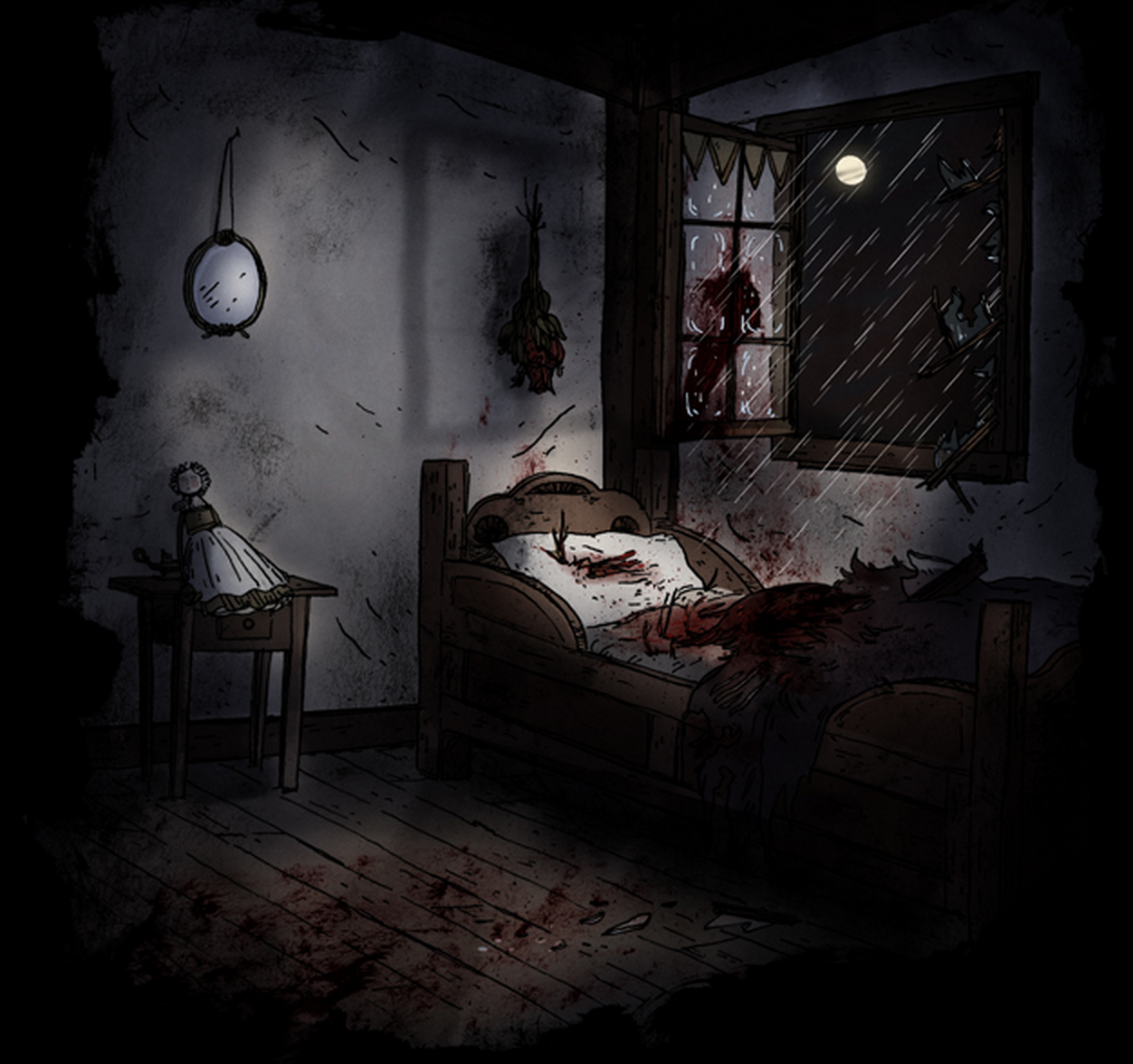
Em Carroll’s “MARGOT’S ROOM” is, first and foremost, a choose-your-own-adventure story (with the story leaning deeper into horror as the comic develops). From the first page, the reader is prompted with a poem and a choice: Screen Shot 2015-09-07 at 11.15.35 PM

Aside from the immediate unease offered by the grisly scene presented by the first page of the comic, the necessity of the reader’s choice to engage and the “path” travelled by the scrolling patterns of the major contributors to the overall dread and horrific impact. The conceit of horror films and animated horror series is that you are being told a story; you passively accept the images, sounds, and dialogue of the tale, and your engagement is limited to your mere presence. Em Carroll, through her use of interactive choice and unpredictable scrolling, removes the passivity of the audience and forces them to choose to immerse themselves in the story and walk (with keystrokes) through the panels of the comic.

The entire story requires being actively unpacked by the reader to be told; once again, this aspect of MARGOT’S ROOM is one of the defining horror elements. The chapters that best display the interfacing of this narrative style and the scrolling involved in the comic are chapters V and II.

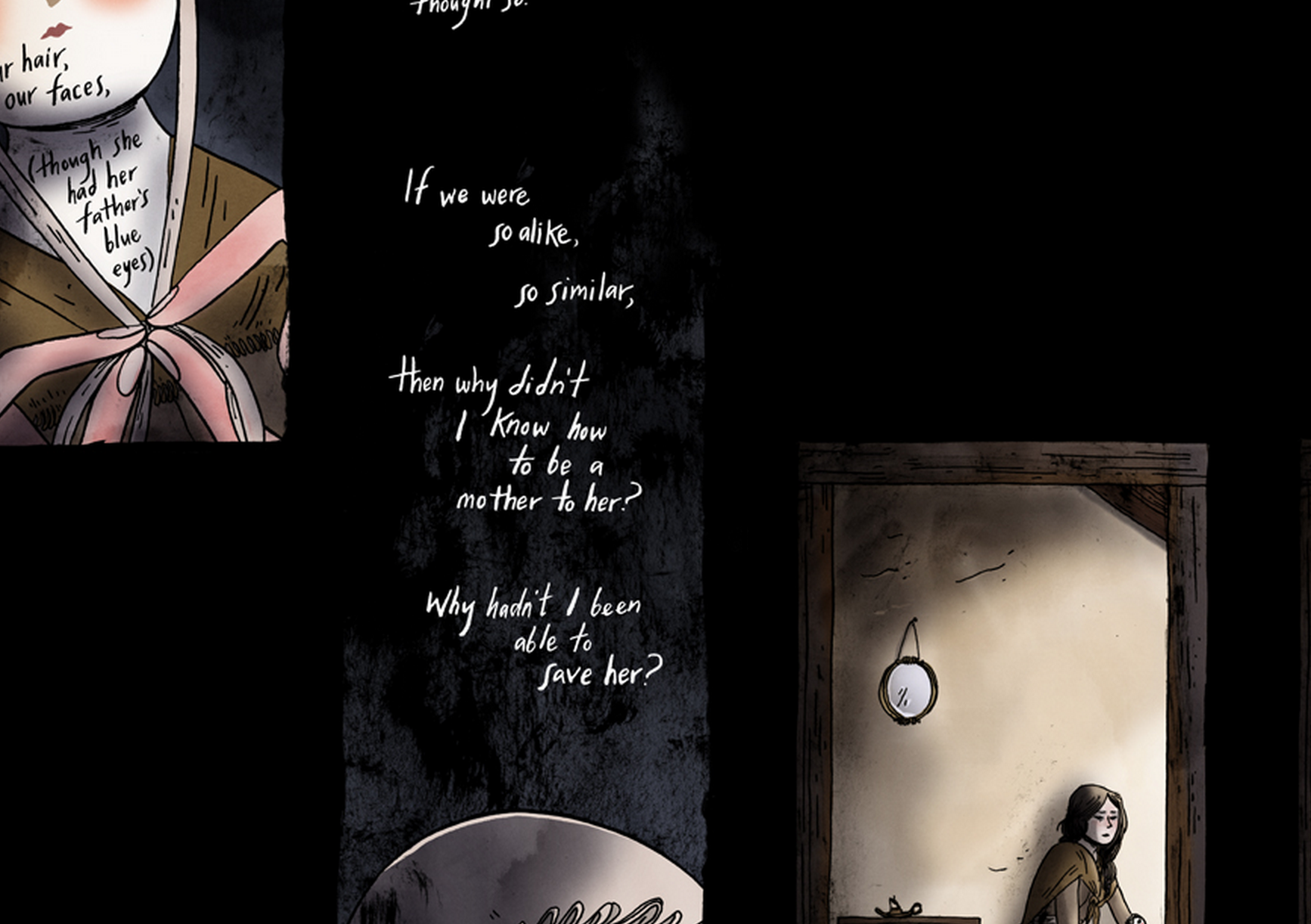
Screen Shot 2015-09-07 at 11.29.32 PM

While very difficult to capture, we see that at this point in Chapter II there is a near-physical “drop” in the story. The reader has to adjust their scrolling, changing the orientation of the comic and providing a sense of dread at the literal descent in the narrative path – again, a descent that the reader chooses to follow, which heightens the suspense of the unfolding dialogue.

This combination of effects is felt the most in Chapter V, where the reader reaches the “climax” of the story. There are three more of the drops mentioned earlier, and following the trail of the panels is at its most difficult and unsettling in this chapter. The discordant movement of the story from panel to panel drags the reader further and further down the screen, at times losing them in the blackness of the background page until they manage to stumble upon another unsettling panel of the murder at the end of the story.  This physical element breaches one of the only sanctities found when regarding horror: the fact that you are completely disconnected, physically, from the story. Carroll’s uses of the discussed techniques creates deep intimacy between the story and the reader, allowing the comic to transcend the flat, distant nature of horror media.