Frankenstein and Further Relation to Greek Mythology

A theme central to Mary Shelley’s Frankenstein is the man’s lifetime pursuit for which they have a basic idea and instinct of, but without fully realizing or understanding how or why they’re searching for it in the first place. To further illustrate and give this idea greater understanding, below is a quote from the philosopher Plato, taken from The Symposium:

“According to Greek mythology, humans were originally created with four arms, four legs and a head with two faces. Fearing their power, Zeus split them into two separate parts, condemning them to spend their lives in search of their other halves.”

This is merely a shortened, summary version of the text, which involves a story concerning the creation of man and the roles of the Gods and Titans involved. But just as Mary Shelly ties in Greek mythology with the subtitle, The Modern Prometheus, I believe this idea to be relevant to the aforementioned theme of this work.

Although this story from Greek myth was more so involving the emotion of love, specifically the desire for a lifelong partner, this can also be seen as the drive of man’s ideas, thoughts, projects and pursuits, as evidenced throughout modern history, whether it be Isaac Newton’s curiosity towards the development of physics, or Nikolai Tesla’s realization of an applicable use of energy that affects us to this day. From the start of the novel, we are thrusts into Captain Walton’s ideas regarding his lifelong passion and meaning in life, especially with the journey he is about to undertake, as evidenced by the quote, “…and I feel my heart grow with enthusiasm which elates me to heaven; for nothing contributes so much to tranquillize the mind as a steady purpose.” Some men give ideas like his merely passing thought and move on with their life. But it is the want and desire that turns an idea, no matter how incredulous it may appear, past the thinking stage and into the doing stage.

This clearly represents the beginning of Victor Frankenstein, and the framework of how he delves into making his creation literally come to life. By merely mentioning his ideas of pursuit (“It was the secrets of earth and heaven that I desired to learn…”), we begin the ride of witnessing the transformation of his dream into its untimely nightmare. I like to think that as we continue reading this, more and more traces to classical Greek mythology and thought will become apparent.
Knowledge In Frankenstein

“How dangerous is the acquirement of knowledge and how much happier that man is who believes his native town to be the world, than he who aspires to become greater than his nature will allow”

I have not yet completed the novel so I can’t comment on Frankenstein as a whole just yet but after reading the first volume one of the many, many recurring ideas that kept resonating through the pages was related to the pursuit of knowledge.

Obviously after years of being exposed to Frankenstein through film, video games, other stories, etc. We know from the beginning that Victor Frankenstein’s experiment does not end well. Whatever is going to happen in these upcoming pages is going to end up with Victor stranded, near death, on some glaciers on the way to the North Pole where he is saved by Walton. As far as how and why this experiment failed I can’t say yet but the text of volume one certainly does seem to place a lot of the initial blame on the pursuit of knowledge itself.

In one of his first letters Walton states to us his want and his need to travel. Ever since he was a child he has slaved over books and let them fuel his imagination and desire. This is a desire that can only be satisfied by stepping onto a piece of the world that no other man has yet touched. Of course alongside all this reading and imagining we learn that Walton sacrificed a lot of friendships and relationships with other humans by spending so much time with his books, and he seems to feel that, because he’s done this, he is due for a great discovery.

“Do I not deserve to accomplish some great purpose?”

Walton asks his sister. He believes that devoting his entire life to his study should now come full circle and reward him with this discovery in the north pole. Walton also talks about similarities he sees between him and his lieutenant, a man of similar kindness to him but who suffers from a deep loneliness. His story also parallels to us Victor Frankenstein’s time at college where he puts aside all relationships and family matters for years while he slaves away at his studies, grave robbing, and experimentation.

In both Walton and Victor’s stories their avid pursuit of knowledge has been associated with loneliness, depression, and in Victor’s case of course the creation of something that he is immediately terrified of. Upon bringing the creature to life, Victor flees from it and when it comes to his bedside he flees his apartment entirely and doesn’t see the creature for years.

Now the science isn’t too explicit on how this creature came to be but a part of me assumes that Shelly wants us to treat the creation of the creature like a birth. Victor himself, while working on his creature, states that this creation would bless him as it’s creator, and likens himself to be the father of this creature. So if we believe that then this creature is a baby new to this world and every single action it makes is a step towards learning something about this world he’s entered. One of his first actions is to reach out to his father and in return his father abandons him for years and we can only imagine that he suffered through years of loneliness and desperation until he and Victor meet again.

So what is Shelly trying to say? As a romantic novel a criticism of the pursuit of knowledge would be vastly against type, but perhaps she is just trying to say that there is a limit to the lengths humans should go. Maybe there’s a line in Nature that we are not meant to cross. Maybe Shelly is trying to advocate for a life lived in Nature as opposed to in the study. Every time Victor feels happy in this volume is when he is surrounded by family or witnessing the beauty of nature, and whenever he’s sick or depressed or haunted Shelly makes a point to let us know that he is missing all the nature happening around him.

I can’t answer these questions yet as I’m only 1/3 of the way through the novel but I’m interested in seeing how this idea of the pursuit of knowledge continues to occur in the novel.

Textual Analysis: The Night of Creation

In the first volume of Mary Shelley’s Frankenstein, chapter V begins with a short paragraph that precedes the pivotal creation scene. Through the selection of fervent diction, incorporation of grim detail, and utilization of haunting imagery, Shelley generates a setting that both exemplifies characteristics of a Gothic novel and foreshadows Victor’s unfavorable feelings towards his creation.

The illustration of “a dreary night of November” with “rain patter[ing]” against the windows immediately generates a gloomy atmosphere. The description of Victor working past “one in the morning” on a cold, wet, and dark night when most people are asleep, stores are closed, and towns are quiet depicts a morbid silence interrupted only by the “disma[l]” cadence of rain drops and sounds of Victor’s work with his “instruments of life.” Shelley’s incorporation of a metaphor for Victor’s scientific tools integrates a supernatural element and poses a question regarding Victor as a God-like figure with divine power. Additionally, the decreasing illumination of a “nearly burnt out” candle further develops a disturbing scene. The darkness from outside slowly bleeds into Victor’s laboratory, casting shadows and indicating that soon blackness will become all consuming.

After much hope, apprehension, research, and “toils,” Shelley reveals that Victor finally succeeds in his endeavor to create life. However, Shelley purposely connects what should be a bright and happy moment with the downcast mood of a stormy night, the unnerving image of darkness, and Victor’s dehumanizing description of his creation. This juxtaposition exemplifies a tactic to foreshadow not only Victor’s unhappiness, but also future horror and dread that will follow his “accomplishment.” Although Victor aspired to create a human being, in this passage he only refers to his creation as a “thing” and a “creature.” Through the description of a “yellow eye” like that of a lizard, an unnatural and inhuman characteristic, Shelley exemplifies an act of dehumanization and foreshadows Victor’s detachment and disgust towards his creation.

Explanation Post: In the Darkness

I was partly inspired by the way Emily Carroll deals with ambiguous endings in her web comics—by having descriptions in the beginning and middle hinting at different conclusions. However, I feel that the ending of my piece is less ambiguous. Although, one could vouch for the beast being an actual creature and/or just a monster-like human.

I was also inspired by Frankenstein. For one thing, I borrowed the image of “dull yellow” eyes from the moment when Frankenstein’s monster awakes. Moreover, in Chapter 5 of Volume I, Victor refers to a section of “The Rime of the Ancient Mariner” when he feels like the creature he created is following him. Almost everyone has had that same fear before—especially when they’re walking around dark places. Darkness can be very scary and your imagination can find all sorts of creatures and dangers roaming in it. And sometimes, there really is something in the darkness.

The Ancient Mariner: Victor 2.0

In chapter V of volume one in Mary Shelley’s Frankenstein, Shelley alludes to the final section of Samuel Taylor Coleridge’s poem “The Rime of the Ancient Mariner”. The allusion foreshadows what is to come for Victor as a result of his endeavors, with the story of the mariner acting as a foil to not only Victor’s experiences but also Shelley’s novel as a whole. Coleridge’s poem tells the story of an old sailor and how his endeavors on the sea accidentally result in the death of his crew at his hands. A young man on his way to a wedding finds the sailor’s story captivating, and “cannot choose but hear” (Coleridge 18). The young man foils the character of Walton, as Walton finds Victor’s story completing enthralling, and the old sailor serves as a foil for Victor and the regrets he has over his aspirations.

The excerpt that is included in the text is quite ominous, and if one did not know the context behind the poem it would seem simply about the fear that Victor feels because of his Creature. Shelley inserts the allusion at the point in the novel when Victor is appalled with himself after succeeding with his Creature. The “frightful fiend” that “doth close behind him tread” alludes to the Creature, and Victor’s fear that he is following him. While this literal meaning is important as well, it is only when you delve into the poem itself that the deeper meaning behind the allusion arises. For those of us who have read Frankenstein before, we know how Victor’s treatment of his Creation drives the Creation to do certain things. This mirrors the way that the old sailor’s actions drives his crew into death, without him intentionally meaning for them to die. Victor’s proceedings in creating life will cause pain and suffering to those around him without that being his intention. Victor also resembles the sailor in that both of them “wear” their wrongdoing around their necks to haunt them forever. In the sailor’s case he is forced to wear the Albatross that he killed as a constant reminder of his role in the curse on him and his crew. For Victor, the situation is not quite so literal. His version of wearing the albatross is having to deal with the Creature’s murder of his loved ones and his constant reappearance. The naivety and ambition in both the old sailor and Victor are ultimately their downfall, and Shelley’s inclusion of this excerpt serves as a warning to the reader of what is to come and what we can learn from them.

Explanation Post: William in the Woods

When reading the part in Frankenstein when Victor discovers William has been murdered, I wanted to know exactly what happened to him. I wanted to be told how he felt before he died, what he thought before he died, and what he saw before he died. I find it intriguing to see the view of the victim before his/her end. I wanted to write what I imagined happened to him. I wrote my piece in the first person because I wanted to explain what happened through the eyes of the murdered. I wrote that Frankenstein’s monster killed William because I do not believe Justine performed the horrific act and it also made sense to me. The monster is just confused and trying to make sense of everything and everyone around him. I wanted to leave it up to the reader to decide if the monster meant to kill William or if he was only trying to seek his help.

William in the Woods

Featured image

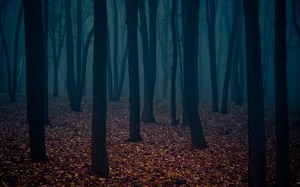
It’s very cold. I lost Elizabeth quite a while ago. It’s slowly getting darker and darker, the sun is beginning to hide behind the rolling hills. I try not to panic, I’m sure my family is out here looking for me. The trees tower above me and I cannot help but feel frightened. All the noises of forest scare me. I hear movement all around. The wind cruising along the leaves, or the animals trampling fallen leaves on the forest floor. I do not know what to think. I try to think comforting thoughts, such as being held by Elizabeth or being right beside my father. But the forest is growing louder, and with it, I grow more worried. I do not know how to survive in the forest alone, I’m only a child that wanted to play a harmless game. Now I am hopelessly lost. These towering trees all look the same and the ground is damp and brown.

Then all of a sudden, I hear something. It is footsteps, but not that of an animal. No, these are heavier. A human’s footsteps. Elizabeth, I’m sure it is! I hear them from behind and turn around to face my rescuer.

It’s no one I recognize. It’s no one anyone would recognize. I back away in horror. What in God’s name is in front of me? I don’t know what to do. I don’t know if it is friend or foe. I run. I cannot help it, I am only a child. I run hard as fast as I can when I hear a voice yell out, “William!” It sounds like Justine’s voice. It’s coming from ahead of me but still sounds far away. I keep running when I am snatched up from behind. Whatever it is is strong and pulls me down behind some trees. I look into it’s eyes but only for a second. The last thing I remember is that his eyes are full of pain. Then everything goes black.