In the Darkness

My imagination is my escape.

I enter my house without a sound. The lights are all off. It’s late.

I’m late.

With quiet steps, I walk past the living room. Nothing stirs around me. Not until I reach the long corridor leading to my bedroom.

I walk forward. Slowly.

Do you ever get that feeling? That someone is lurking right behind you?

The lights suddenly flicker. Maybe it’s a mischievous poltergeist messing with the electricity. Maybe it’s the lightning of a faraway, nonexistent storm. Because, of course, a storm can’t form inside a house.

But I can imagine one doing so.

I hear whispers coming through the walls. Maybe it’s the voices of fairies. Introducing themselves to me. Maybe they need help and are pleading for me to save them.

But I’m the one who’s trapped.

Turn back. You’re in danger.

My heart is pounding now. Maybe I’m just hearing the pounding of bass drums in another room. Someone playing a concert with an audience of none. Or the pounding of a fist on a table. Angry pounding.

Turn back.

The lights flicker again, and for a second I see a shadow that’s not my own on the wall to my right. I turn my head a bit but I don’t look back all the way.

Boom. Boom. Boom.

A drop of sweat rolls down my cheek and falls off the edge of my jawline. Boom.

I keep facing forward but my eyes close. My mind projects an image onto the blackness.

The looming shadow, a shapeshifter, settles on one form.

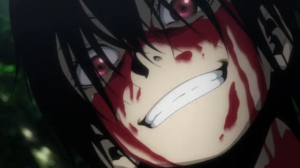
Claws. Bared teeth. A hideous face. Hungry eyes. A rabid beast. With a heaving chest, but I don’t hear its breathing. I open my eyes. The lights flicker once more, and the shadow is larger than before.

Turn back.

I walk forward— now with hurried steps. The pounding in my ears grow louder.

Run.

I rush to my bedroom door, open it, go inside with my back against the wall, and shut the door. The whispers are silenced.

I reach my hand out to turn on the lights, but there’s already a small light in front of me.

I should’ve listened to the voices.

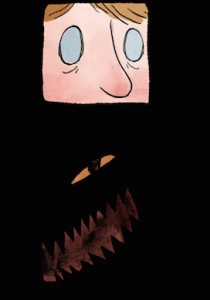
There’s a pair of dull, yellow eyes staring back at me. I also see rows of pearly white teeth. I can hear his harsh breathing now—each breath comes and goes at steady pace.

But his eyes aren’t calm. There’s a fire in them. A dull, yellow fire.

The creature takes off a long chain from his waist. I catch sight of a glimmer of gold at the center. He raises his monstrous arm up slowly.

Sometimes, my imagination can’t be my escape.

– – ♥
The Ancient Mariner: Victor 2.0

In chapter V of volume one in Mary Shelley’s Frankenstein, Shelley alludes to the final section of Samuel Taylor Coleridge’s poem “The Rime of the Ancient Mariner”. The allusion foreshadows what is to come for Victor as a result of his endeavors, with the story of the mariner acting as a foil to not only Victor’s experiences but also Shelley’s novel as a whole. Coleridge’s poem tells the story of an old sailor and how his endeavors on the sea accidentally result in the death of his crew at his hands. A young man on his way to a wedding finds the sailor’s story captivating, and “cannot choose but hear” (Coleridge 18). The young man foils the character of Walton, as Walton finds Victor’s story completing enthralling, and the old sailor serves as a foil for Victor and the regrets he has over his aspirations.

The excerpt that is included in the text is quite ominous, and if one did not know the context behind the poem it would seem simply about the fear that Victor feels because of his Creature. Shelley inserts the allusion at the point in the novel when Victor is appalled with himself after succeeding with his Creature. The “frightful fiend” that “doth close behind him tread” alludes to the Creature, and Victor’s fear that he is following him. While this literal meaning is important as well, it is only when you delve into the poem itself that the deeper meaning behind the allusion arises. For those of us who have read Frankenstein before, we know how Victor’s treatment of his Creation drives the Creation to do certain things. This mirrors the way that the old sailor’s actions drives his crew into death, without him intentionally meaning for them to die. Victor’s proceedings in creating life will cause pain and suffering to those around him without that being his intention. Victor also resembles the sailor in that both of them “wear” their wrongdoing around their necks to haunt them forever. In the sailor’s case he is forced to wear the Albatross that he killed as a constant reminder of his role in the curse on him and his crew. For Victor, the situation is not quite so literal. His version of wearing the albatross is having to deal with the Creature’s murder of his loved ones and his constant reappearance. The naivety and ambition in both the old sailor and Victor are ultimately their downfall, and Shelley’s inclusion of this excerpt serves as a warning to the reader of what is to come and what we can learn from them.

Explanation Post: William in the Woods

When reading the part in Frankenstein when Victor discovers William has been murdered, I wanted to know exactly what happened to him. I wanted to be told how he felt before he died, what he thought before he died, and what he saw before he died. I find it intriguing to see the view of the victim before his/her end. I wanted to write what I imagined happened to him. I wrote my piece in the first person because I wanted to explain what happened through the eyes of the murdered. I wrote that Frankenstein’s monster killed William because I do not believe Justine performed the horrific act and it also made sense to me. The monster is just confused and trying to make sense of everything and everyone around him. I wanted to leave it up to the reader to decide if the monster meant to kill William or if he was only trying to seek his help.

William in the Woods

Featured image

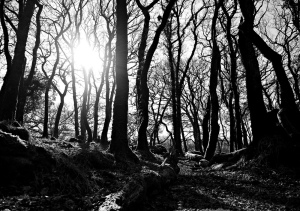
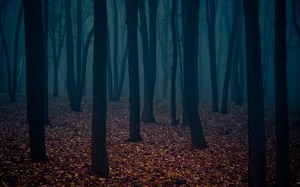
It’s very cold. I lost Elizabeth quite a while ago. It’s slowly getting darker and darker, the sun is beginning to hide behind the rolling hills. I try not to panic, I’m sure my family is out here looking for me. The trees tower above me and I cannot help but feel frightened. All the noises of forest scare me. I hear movement all around. The wind cruising along the leaves, or the animals trampling fallen leaves on the forest floor. I do not know what to think. I try to think comforting thoughts, such as being held by Elizabeth or being right beside my father. But the forest is growing louder, and with it, I grow more worried. I do not know how to survive in the forest alone, I’m only a child that wanted to play a harmless game. Now I am hopelessly lost. These towering trees all look the same and the ground is damp and brown.

Then all of a sudden, I hear something. It is footsteps, but not that of an animal. No, these are heavier. A human’s footsteps. Elizabeth, I’m sure it is! I hear them from behind and turn around to face my rescuer.

It’s no one I recognize. It’s no one anyone would recognize. I back away in horror. What in God’s name is in front of me? I don’t know what to do. I don’t know if it is friend or foe. I run. I cannot help it, I am only a child. I run hard as fast as I can when I hear a voice yell out, “William!” It sounds like Justine’s voice. It’s coming from ahead of me but still sounds far away. I keep running when I am snatched up from behind. Whatever it is is strong and pulls me down behind some trees. I look into it’s eyes but only for a second. The last thing I remember is that his eyes are full of pain. Then everything goes black.

Explanation post: His Face Forever Red

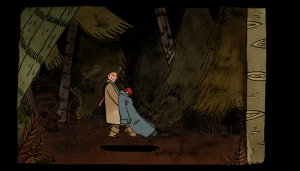
Here, I extend the backstory of Emily Carroll’s “His Face All Red” and by doing so, attempt to humanize the anti-hero of the comic.

I was surprised at myself when I sat down to write this post and this story came out. I always appreciate films and books that try to humanize the anti-hero/sociopathic character (Frankenstein anyone?); I believe it is more interactive in the sense that the reader is forced to reflect on their interpretation of that character. There were very human reasons why the anti-hero killed his brother and I strived to highlight just an example of “why?” in my story. I also wanted to provide a bit of background to instill more emotion and to lengthen the brothers’ relationship. I didn’t feel like, in the original comic, that the main brother felt any malice or hate towards the more popular brother- it was outside sources that led him to madness. So, I introduced the father character.

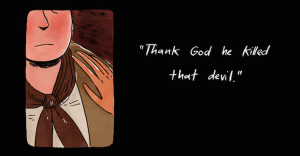
I decided to go the demon route because of the line the “brother” says when he comes back from the woods, “Thank God my brother killed that devil”. I read that as words only the demon brother wanted the other brother to hear; he said the words aloud, but it had a double meaning. It was a way of communicating to the anti-hero that the “brother” knows what happened. Not only that, but he says it himself, a “devil”. Gods and demons in mythology have a grand time messing with the mortals- here I saw no exception. Also, I had a problem with the abrupt ending with the corpse being turned over, eyes open. I wasn’t sure how to interpret that so I expanded on the possibilities and made an ending I was happy with. Too much ambiguity can be annoying to some readers, but just enough is intriguing. I strived for the latter with the last line.

The punishment at the end very much reflects Greek mythology. Most punishments are extended and violent (Ex: Prometheus), but nonetheless get the message across.

The moral I wanted the reader to leave with is to appreciate who you have in your life and don’t let outside sources hinder your thoughts. This is the reason I put the flashback in the beginning- the brothers didn’t have a negative relationship when they were alone.

Make your own choices. If you are unhappy, reflect on why, and make the necessary changes. If you don’t, you will wind up shut in a hole with your dead brother for eternity.

His Face Forever Red

I went to the woods to be alone for a while.

woods

  After a time, my brother found me (he always knew how to find me).

You shouldn’t listen to Papa”, he said. “His generation doesn’t understand that an artist like you thrives on creativity, not manual labor”.

    My brother always did understand me.

He always compares us. I can never live up to his standards like you can.”

Bah!” he said, clapping me on the shoulder. “There’s more to life than athleticism and brawn. Girls love romantics like you. Besides, I have faith in your talents, we’re not going to be here forever. Oh! Speaking of girls, I have to go meet Alice. I’ll see you later.”

And then he left for university.

university

Papa was so proud.

Now, here I am again.

hole2

Once a place for respite and reflection, these woods hold a lifetime of memories. 

Now, namely, a memory of death.

And something else.

demonbrother

(I still haven’t figured out what)

I look at the lifeless lump of flesh that used to be my real brother.

brobody

His body… it’s…

down

here… in this gaping hole.

His face still bloody and red.

red

Is this a gateway to Hell? 

gateway

I start exploring the walls while my inner dialogue continues.

Surely that imposter is a demon. My brother doesn’t have a twin.

devil

Has it come to haunt me for what I did?

When the beast looked into my eyes that night, it knew everything in my soul.

showdown

I could almost feel it combing my mind. It must know the uncharacteristic pleasure I derived from holding my brother’s weeping wife or the new desk I bought with the money his livestock afforded me? Before that anomaly shook our sleepy town with its appearance, I planned to write my way out of here… away from the guilt.

For, this must be guilt. Never has anything plagued my mind so.

That beast knew my hatred-

No…

my jealously towards my brother. No one will believe me now, but I did love him. But, if you pit any lesser person against someone who’s good at everything, some bitterness is bound to ensue. My failure knows no bounds after all the times my father made me feel inferior; it never lessened the sting.

The wolf was the demon.

A catalyst with a motive.

That demon knew the joy I felt when my brother left for college… knew I wanted that again. I didn’t have to compete anymore, I could just be… me.

I should have just left

(and never looked back)

Why the hell did I stay? Well… for the same reason people stay in dead-end jobs for years; they’re comfortable and hate change. It’s the reason my father is so unhappy.

Blast you, hindsight! I should have left. I should have gone so far away… to a villa in Italy perhaps, where some of my idols studied.

italy

That demon also knew what I would do that fateful night.

killed

A slow clapping sound fills the cave, echoing off the walls and reverberating in my ears

“How perceptive”, a familiar voice says.

eyes

A slow

  cold

    tingle

trickles down my spine.

I turn to see my dead brother’s blinking bloodied face staring back at me from an upright position

bloody face

“Impossible”, I breathed.

One would think, right?”, the former corpse supposed, “but in your selfishness, dear brother, it seems you have neglected to leave yourself an exit”

Surely I did. I climbed down by-

The rope is gone.

I turn my gaze upward to the starlit opening of the hole to see my brother’s twin smiling maniacally down at me.

You have turned what joy there is in family into hate and jealously”, the imposter said in a resonating baritone, “You are to spend an eternity

down here

with your beloved brother. In death, you will finally be equals. For do not be mistaken, he is the greater of the two of you. You must die to be missed… and even then, I am certain you won’t be.”

And while I screamed in protest, the creature extinguished all light in the deep hole and sealed it from above.

That left me, my cries bouncing aimlessly off the earth,

and my blood-soaked “dead” brother to the mercy of darkness.

Silence blanketed us as I grappled with understanding my now eternal situation.

So”, my glowing red brother said, “Shall I return the favor?”

glowing red

The End

Sample Explanation Post: A Slip and a Fall Away

I’ve had this short little piece of fiction on my back burner for a while. At the time that I started it, I’d been going through a Kate Griffin phase. Her urban fantasy (e.g. Matthew Swift series, Magical Anonymous, etc.) engages with a unique perspective of the modern world – where magic and Other Things can be found not in nature, but in the metallic, electric world we now live in. How are perfectly ordinary objects and people sometimes made greater or strange by a shift in perspective? I was inspired by the ways in which she – and Stephen King to an extent – juxtaposes eerie atmospheres against wry narrative voices to create this novel effect. Griffin also plays on the “we” versus “I” division (as in, there is often very little separating the individual from the community) and I tried to capture that in my language.

Sample Fiction: A Slip and a Fall Away

It is 12:47am on a Wednesday – a day of no particular significance, sitting square in a month with no corporate holiday, filling in a colorless year that will soon be forgotten. The congested, screeching friction of hot metal and harried commuters has cleared to long stretches of silence. Lethargy broken only by the occasional passing rush of an errant driver, the flickering lights of a gas station, and the incessant chirps of scraping, membranous wings. It is in this perpetual cycle of day and night that human souls are crushed molded by unyielding, mundane, and entirely artificial forces – a brief respite available only in that sliver of time between sleeping and waking.

See: to your right – the gothic archways with their curves and crosses, framing stained glass that, in the light of day, paint inspiring tales of needless sacrifice and bloody hate and a rapturous End that will swallow the world. How powerless it looks now, though, with no Pied Piper on the stage singing innocent children and sinful rats alike to their burning, eternal salvation. What could this wondrous architecture of man be but the Vessel of divine love?

See: in front of you – the perfectly bland and symmetrical honeycombs of cubes and desks and halls that, under florescent lights, harness the plodding potential of the drone within the man. When the burning sun sets and the bulbs dim, the Hive disperses to find respective rest and sustenance, a temporary exodus before the inevitable return.

See: them accept the pause that they’re all given, gifted by the presence of a belabored Sandman (and a Tempur-Pedic mattress). These dreams that come and go will, in some near time, disappear into the seductive whispering maw of the permanent Black – but until then, drift easy, drift free for a finite moment.

Thus does the summation of human existence plod along, occasionally captured in the harsh glare of a Shell Service Station, shining alone on the corner of a deserted street at 12:47am on a nondescript Wednesday. It is a glorious, underwhelming moment of perfect, middling, banality.

Right here, at this intersection – nightly distributer of fuel for the modern rider and his iron steed, and Doritos bearing Savior of the drunken man – a bus sweeps through on the final leg of its journey to the garage. It is emptied but for an evidently well-loved copy of Playboy splayed next to a suspicious dark stain, and a single passenger. Snoring contentedly with his neck bent against his right shoulder (it will ache when he wakes), and the crown of his head resting against a smudged window, this modern-day Rip Van Winkle remains oblivious when the bus merrily roars through his stop without hesitation. There will be no off-brand Snickers and egg-salad sandwich for him tonight.

The driver is intently focused on the road ahead, as though by will alone he can suddenly reach the end of his route. And yet, the end comes and goes with not even a whimper. Bus “Not in Service” (and when did the LED sign lose its numbers and destination?) continues forward and leaves the grainy imprint of the garage behind in a burst of exhaust fumes.

Winkle is bounced painfully against his once-pillow when the bus jolts from a badly paved dip. He looks out the window with a groggy, uncomprehending stare. Though those are certainly Austin trees – dried, stubborn tufts of green hiding unforgiving nests of bird shit – and these are certainly Austin roads, cracked, uneven messes that they are, there is only an echo of the familiar. This is no part of the route he has followed for the past three years, and no part of the city he has lived in for four. Winkle turns to the driver but pauses before the question even leaves his mouth.

This scruffed mountain man whom he has seen and greeted day in and day out, but whom he has never known (the same way that the dull-eyed grocery bagger can never be known, nor the IT representative who blends together with every other IT representative over the phone) is gone – and Winkle is left adrift. Though the driver’s shoulders are the same broad wall of sinew and flesh, and his hair the same wild mop of dirty blond – or maybe it is a light brown – and his face the same generic face of all driversandwaitersandcashiersandwalmartmanagers, Winkle cannot find comfort in this figureless figure because he is not the same.

Winkle squints in confusion as the tiniest bit of fear creeps into his asthmatic lungs. There is a flickering in the peripheral edges of his vision when he shifts his eyes away from the bus driver, but perhaps this merely heralds the onset of stressed exhaustion. Perhaps what he sees are oddly gruesome floaters in his eyeballs, and not the peeling, fluttering, transparent skin of the driver fading into cracks of nothing. Perhaps he is falling into the black grasp of a diabetic coma, and imagining the dark slivers that pulse around the driver and grow into consuming shadows.

The terribly ordinary commuter is struck with an overwhelming desire to run, to hide, to escape this thick, sludgy dread that chokes his wheezing throat and coats his chest like the slimy imprints left by warm, blood-soaked fingers. As Winkle falls on to the grimy floor, gagging, the Driver turns around with a smile pasted on his melting, wax face – a creature of dripping flesh and oil with bones of rust protruding from his hollow cheeks. A ring sounds in the distance, as “Stop Requested” flashes across the ceiling, and the world slips sideways and over. Outside the windows pass flashes of death and worse and vast deserts of burning darkness, until Winkle can see no more.

He cannot see (or hear or speak) because there is only enough blood to feel, red life trafficking in the tunnels beneath his skin as he is flayed, seared, stripped and torn from the inside out. Interminable moments of not-pain and not-death until he feels translucent – until he is nothing but a beating, oil-pumping chrome heart wrapped in skin…

At 6:42, the bus returns to its route. Women in suits and children with lunchboxes and men in shiny leather shoes alight and descend. Another Thursday, and another day closer to the weekend. They say “thank you” to the driver – sometimes not even this – with their ears plugged and eyes ahead. To them, the driver is as faceless and forgettable as the motionless, smiling commuter sitting in the very back, who smells vaguely of eggs and caramel.

Sample Analysis: Illness in Margot’s Room

Emily Carroll’s comic, Margot’s Room, can be read both on a literal level (a man transforming into a werebeast) and on the metaphorical (the onset of depression and domestic abuse following the death of a child). Patterns and clues tend to emphasize narrative ambiguity rather than clearing it up. One of the main sources of confusion for me is the role of sickness in character deaths and transformations.

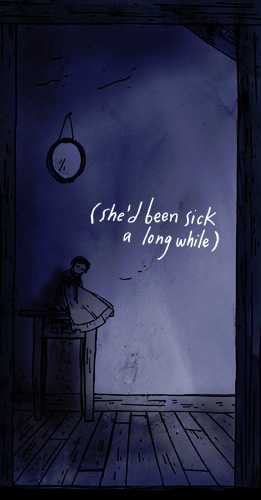
When we are introduced to the narrator, she notes that “I was feeling sick” during her father’s funeral.CaptureFollowing on the heels of her understandable response to this dark situation, she implies to her future husband that she is not shocked by her father’s death because he’d been “sick for a long while” – and perhaps doesn’t even view it as “tragic.”

CaptureIllness, and in fact, that exact phrase “sick for a long while” heralds another dramatic turn in the plot when Margot, their daughter, dies off screen.

Capture

Up until this point, we see that sickness (particularly that of the “long while” variety) serves as a precursor to the rise and fall of relationships. The narrator’s relationship with her father appears to be stilted and perhaps estranged (in early panels, she mentions that the entire village shows up for the funeral, but no one approaches her or even attempts to find her). Her stoic reaction quickly transitions into bright scenes of her wedding (again, with no villagers in the background) with Gilles. The father’s illness, her own sickness are never mentioned again now that she has what she desires – attention, affection, and Gilles. Later, the narrator’s guilt that she is a failed and unsuitable mother is reflected in her statements that she “never thought” her daughter was like her (that in fact, Margot was so physically similar to her husband). This discomfort is linked to Margot’s “long” death, and the eventual destruction of the narrator’s marital peace. Finally, Gilles himself is described as changed and transformed, paralleling the deterioration of household peace.

Illness, if understood literally, almost functions as a curse following the narrator and tainting those in her life. If applied on a metaphorical level, we can see that illness describes the narrator’s isolation from the community, and seems to insert itself into relationships in which the narrator is overwhelmed by self-doubt and/or resentment. Rather than visually confronting these moments through memory, the narrator only shows us her rationalization, her repressed guilt (deserved or not) through tenuous repetitions of “sick a long while.”